Music to Make Us Believe the Gospel

Third Eye Blind is the reason I didn’t kill myself in 2010, so how’s that for the power of music? I can still remember sitting in my car, listening to Motorcycle Drive By, and deciding I wanted to live. I wasn’t teetering on the edge, ready to take the plunge, but the thought was there, and it lingered, and it looked good.

It’s a good song. Didn’t change anything about my life, but it took all the reasons – however intangible and impossible to articulate – that I wanted to live, and drug them up out of the depths and onto the beaches of my heart.

I still don’t really know what they were. I don’t know what I thought was going to justify going on another day. But that song – an angsty recollection about a doomed relationship with a girl from New York – sounded like hope. And it still does.

It sounded like resurrection, but that wasn’t even in my vocabulary when I was 16.

I think I can identify that as a turning point in my life, maybe the really big one. If I wrote an autobiography it’d be it’s own chapter. I sat in a car one evening and started to believe the gospel while a pagan sang about a girl.

That’s how music works. Because that’s how people work. I met Jesus months later, but it started there. I was done with something, even though I wasn’t sure what it was. Eventually my head-strings caught up with my heartstrings and I trusted Jesus in a tangible way. Because I heard a song that sounded like resurrection.

That’s why we believe the gospel more deeply when we encounter God in musical worship. Especially corporate musical worship. Music knits people together around the Conductor.

That’s why our faith doesn’t wither away amidst the onslaught of failure, depression, and hopelessness. God is a disease, and once we’ve caught Him too many songs remind us of Him. God is a disease and music is a dirty syringe.

Thank God.

I’m at a worship gathering as I write this. The crowd around me is singing Be Thou My Vision. High King of Heaven, my Treasure Thou art, they sing. They’re bloody well right, and it’s never more tangible than these moments.

Telling Better Stories


I recently spent a semester studying at the University of Oxford through the SCIO program, where I delivered a TED-esque talk very similar to this. Although previously published via the illustrious medium of Facebook, it seemed worth another share here. Thanks to Will and Ryan for allowing me to (hopefully more than occasionally) hijack the blog. 
I don’t know if you’ve seen it yet, but King Lear at Blackwell’s was an amazing experience. I know a lot of us went last Tuesday. Personally, I couldn’t recommend it more. It was well worth the £17. Not only was it interesting because it’s Shakespeare (duh), but also because there were only five actors. I don’t know how familiar you might be with King Lear, but there are far more than five characters.

Needless to say, there was a lot of actor-sharing. A single actor would use props like scarves, glasses, or jackets to let the audience know which character he was at the time. So for example, two of King Lear’s daughters are played by a single actress, but we can tell the difference by the different scarves she wears. These two characters would often appear in the same scene, so the actress would wear one scarf and hold up the other as if the scarf were the character. She and the others on stage would look at it, talk to it, touch it. We as the audience come to understand that the object is a person—at least for these few hours on this stage in the middle of a bookstore.

But then I got to thinking: how often do we take this experience out of the bookstore? We understand objects as people, people as objects. Look at me. You probably see dark hair, glasses, and a flower skirt. You’ve already come to understand me as a thing, an object. And I’m not blaming anyone—we all do it. You make assumptions about me based on the way I look, the way I talk, the way I present myself. You see my body and determine I’m a woman. You see my glasses and think I’m smart/hipster/edgy/cool/trying too hard. You see my hair and decide I probably should have just put it up today. And let’s not even talk about all the ways you’ve probably already guessed that I’m not a very practiced public speaker.

You’ve done all of this within seconds. I’m a thing to you.

Maybe, if we’ve ever had a conversation, it’s different for you. Maybe you know I’m from Hawaii, or that C.S. Lewis in Context is my primary tutorial, or that sleeping is my favorite pastime. Maybe you’ve seen me eating too many cakes at teatime. You know facts, statistics, snapshots, if you care to look or remember. But these are all still things.

You might never know my story. You’ll never know that my older brother has special needs. And you’ll never know what I went through growing up as I came to realize what this meant. You’ll never know about the cancer my mom had my sophomore year of high school and the depression that came with it. You won’t know the addictions, the late nights, the angsty journal entries that pervade almost every memory of my growing-up years.

We’ll never talk about the ways I’ve overcome these, that I still fight to overcome these. You won’t feel the hugs from my mom, meet the friends who encouraged me, or hear the words they said. You won’t read the same books in the same way I did. You won’t discover the same epiphanies, or participate in the processes that brought me here.

Because to you, I am an object, a thing easily definable and dismissed, a scarf on a stage in a bookshop.

And to me, you are that.

I don’t know your story—maybe I never will. I may never even know what your primary tutorial is or what state you call home.

And as much as I want to know your story, sometimes I have to remind myself that I can’t. Intimately knowing every person here during a single semester is just not possible, as much as we might converse or interact. And as important as our stories are in the past, what about us in the present? The way we process information, the connections we make, the inevitable influence of our memories?

I guess, maybe, we can’t really know each other. Maybe.

But that doesn’t mean we have to be objects to each other. You are no simple scarf in a play that signifies a name, a voice, a shadow of a personality. You are so much more—and so am I, and so are all of us. That’s just true.

It’s going to take a lot of conversation, and a lot of constant imagination to realize that truth; open, empty rooms in our minds where we allow other people to exist in possibility. Maybe I am more than these glasses or this hair or even this talk. Maybe you are more than a haircut or a smile as we pass by. Maybe you’re on your way to a lecture where you’ll sit with a new British friend, awkwardly attempting to talk about the weather before you break out your phone to text your mom—man, you miss her a lot—and tell her about what you cooked for your food group last night. Maybe your life is just as complex as mine.

None of these things probably happened—and that’s okay, because I humbly realize that I’m no psychic. I don’t actually know. But maybe these stories are an exercise for me in imagination, helping me to see you as more than an object. Maybe stories—even just the ones I make up—will make you and I more human.

In the final scene of King Lear, one character cries over the “body” of another. It moved me to tears. But the “body” was a just a dress that the dead character had worn, draped over the stage. And this was the moment of greatest humanity: that in the telling of the story, the object had become a person.

Let’s tell better stories about each other.

The concrete and excellent impact which “books” have had on my life…

If you think that reading books just closes you off from the world, making you impractical and impersonal, you should consider what effect interactive, thoroughly involved and participatory reading has had in my life.

1- it introduced me to Spiritual inwardness and much wisdom

2- it helped guide me through no small depression and into action and purposeful life

3- in particular, it led me to volunteer several times and later work two summers at a Summer Camp for people with Special Needs, Camp Barnabas. This was no small feat for a shy, sheltered young man who knew at the time nothing about caring for others or about people with special needs. This in turn led me to be a team leader / staff supervisor at a small Summed Camp in New Mexico (which I thoroughly surprised myself by making not a terrible job of). And these experiences have certainly taught me a variety of excellent skills both practical and people-based (and self-based, like fear-management, which started in many ways with C. S. Lewis and led to volunteering at Barnabas, then working on their team that was in charge of the Rockwall, zipline, and ropes course, and so on — this was supplemented by Kierkegaard, Donald Miller, Dostoyevsky, Pascal…). Come to think of it, the inward life that books taught me, or that I embraced and learned through books, perhaps I ought to say, also provided me with the courage to pursue the possibility of the great, outrageous, living beauty who is my wife now. (Much of this also involved a long-time conversation with God, but the role of “books” generally is undeniable in all my major life decisions, which I value very much and do not believe have been foolish, at least in God’s eyes.)

4- it has helped make dull moments and dull jobs more meaningful or at any rate less dull; by 1st helping me to understand how mundane things tie into the big picture of the universe, humanity, and God in a way that is meaningful to me. Work and the very fabric of this world, however mundane, are holy and good and your conscious perspective about them affects your ability to be bored or exultant. Or 2nd by giving me plenty to think about, poetry and philosophy to learn and recite and dwell on, even while, or perhaps especially while, at work.

5- it has helped me connect with people who have similar thoughts and feelings, even though they may never have seemed to in the first place or never had the same way of thinking about it; it has helped me connect with people who are different from me.

I could go on. “Books” will not close you off to the world anymore than anything else, and, if you let them, if you work with them, they can help you make your life into something practical, beautiful, thoughtful, helpful, and Godly.

(My father and others also helped immensely with all of this, but this post is specifically about the influence of “books,” read with thorough involvement, like I said. If you don’t believe me, it’s your loss.)

Observations on Secularism, Christianity, and Islam

You don’t have to read this to get my comments, but in all fairness this blog post is what inspired my blog post:

http://theweek.com/articles/452475/worlds-most-ancient-christian-communities-are-being-destroyed–no-cares

Several things are striking about this:

1) U. S. involvement is in many ways the cause or catalyst of this situation. And yet

2) U. S. involvement is acting on a set of Islamic laws which condone and encourage and even command such behavior – the US doesn’t provide the evil actions to Islam, they provide the incentive for Islam to show its worst. (Mimetic rivalry is at the heart of this, at the heart of the U. S. and of Islam.)

3) There is no real explanation for why “a secular law” is of much real benefit for the situation precisely because America’s involvement in the Middle East **is secular** and is exactly the proof that people ought to recognize as proof that nothing about being secular will make you neutral or fair or just or balanced towards those who disagree with you.

In other words, in conclusion, while a spirit of peace and hope is essential to reconciliation (I think St. Patrick, St. Francis), it is also important to recognize that in a world of people with hellish desires, you will get hellish things (from Secularists and Islamists and Christians) unless you can spread the source of hope and peace – Christ himself.

(This is why, in the past, I have quoted Dumbledore imploring Cornelius Fudge to see reason about thw death eaters as being relevant to the situation with Islam – because Dumbledore is also the man who most of all offered his friendship and forgiveness, his humanity, to Lord Voldemort, by always calling him by name, speaking calmly and with reason. We need an attitude which recognizes violent worldviews and cultures caught up in mimetic rivalries, but which also speaks with grace into them. An attitude of ignorance will only compound the problem.)

Want To Write For INFP Theologian?

Canestra_di_frutta_(Caravaggio)

Basket Of Fruit, Caravaggio, c. 1599

Here at INFP Theologian, we say things. Nobody pays us to say things, but we say them anyway. We like writing here, because:

A) There’s no requirement about uniformity. Ryan doesn’t always agree with Will, who doesn’t always agree with Ryan, who doesn’t always agree with Elyse, who doesn’t always agree with Abby.

That’s far-reaching, too. Since writing for INFP Theologian doesn’t mean you endorse the ideas of other writers at INFP Theologian, you don’t have to own anything anyone else here says. From the outset our cards are on the table and our cards are our own. If you write here, we don’t have to agree – not even a little, and that’s cool.

B) The culture of the blog is aggressively Type-B, meaning nearly anything goes. Wanna write a post per week? Do it. A post every 2 weeks? Do it. A post per month? Deaux it.

We encourage semi-regular contributions, but there’s no hard and fast rule. After all, we’re INFPs.

C) We like debate but we’re also nice. By design, we enjoy engaging the marketplace of ideas, meaning that competing ideologies are welcome. It’s kosher to become impassioned and write a visceral article about such and such topic without fearing that a relationship is on the line because of it.

That said, writing a post about how The Jews Are Plotting To Destroy Christmas By Contaminating The Water Supply In Dallas Texas And Kidnapping Taylor Swift would probably get you ejected from your non-paid, unmonitored position as a writer here. But, really, those are loose parameters.

D) We tend to put out philosophically or theologically oriented content, but basically any topic is fair game. Sex. Theology. Aging. The new Donald Miller book. Coffee. The presidential debate. Coffee. Pop culture. Coffee.

If all of your posts are about how to operate Windows 98 on your Compaq Presario desktop, you probably won’t get any hits, but nobody will question you.

E) It’s fun. Writing is fun. Writing as a collective is more fun. Especially one that is equal parts vibrant and laissez-faire.

**********

So if you’d like to write for INFP Theologian, email us at: infptheologian@gmail.com

Things Are Different Now.

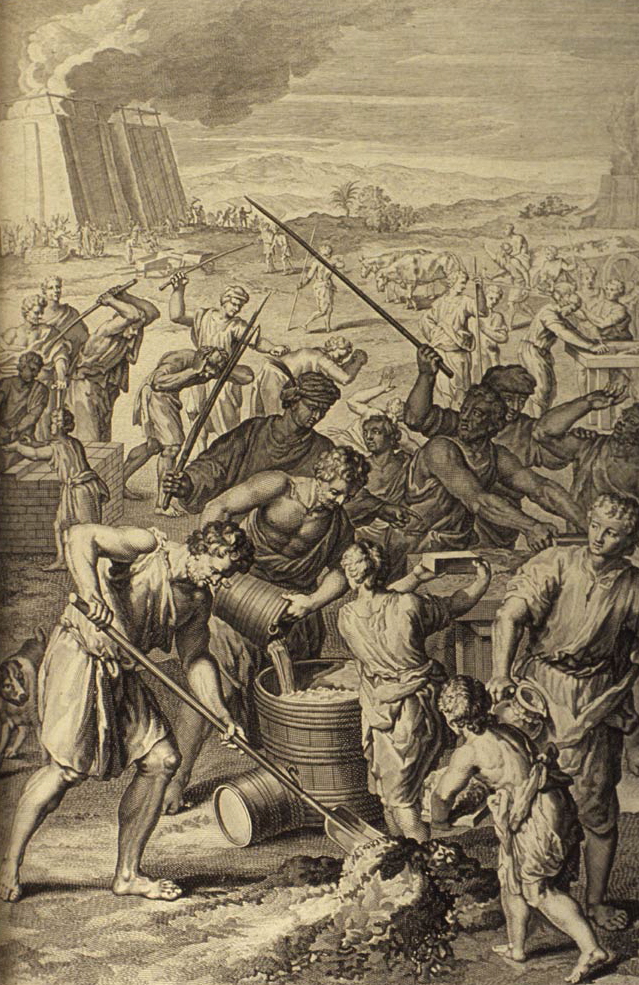
Figures_The_Israelites'_Cruel_Bondage_in_Egypt

The Israelites’ Cruel Bondage in Egypt, by Gerard Hoet (1648–1733)

Exploiting areas of moral overlap between the bible and contemporary culture is always a good principle. Contemporary America is essentially a culture-in-transition, so there’s a lot of ambiguity present in our national consciousness, but there’s plenty there to be taken advantage of.

It’s common to read melodramatic laments from the John Hagees and Robert Jeffresses of the world about how far America has drifted from Christian principles it used to cohere to. In reality, there was a time when our nation’s basic moral framework overlapped with the moral vision of the Christian faith in certain areas and not so much in others. We came to hold those areas of overlap very dearly and ignore the areas where the American moral framework fell dreadfully short of the biblical worldview.

But much of the angst that American Christians feel today about the nation’s supposed drift away from biblical values is actually a misplaced panic at the fact that the cultural shift we are experiencing is shaking things up so that the specific points of overlap between the American mindset and the biblical mindset are different. Top that off with the fact that America no longer pays institutional lip-service to the Christian religion, and we’ve got a new cultural situation that, although not worse than the one our grandparents grew up with (even in the good ol’ days, America was a kiddie pool of sin), is distinctly different, and we have to engage the culture accordingly.

For example, the contemporary America is not, like the America of yesteryear, consumed to a fault with questions of personal moral piety. Every culture inherits a doctrine of sin even if they do not, strictly speaking, have the necessary vocabulary to identify it. While sin is what it is, because truth isn’t relative, it has been uniquely understood through the ages.

The contemporary American doctrine of sin, if any such monolithic agreement can be clearly identified, is concerned primarily with sinful systemic structures. Never before has Total Depravity been an easier concept to sell. In the last several centuries, our notions about right and wrong have been torn asunder and then stitched back together by Darwin, Derrida, Nietzsche, Heidegger and other heavy-hitters. We’ve watched totalitarian demagogues rise and fall while honest, God-fearing citizens marched along to the rhythm of Apocalypse. We’re not really sure what evil is in the abstract, and we’re not entirely convinced it exists. But rarely do we fail to identify it when it appears in concrete form. There has not previously been a generation more sensitive to the pervasiveness of coercion in human behavior, and the contemporary western doctrine of sin deals extensively in the difficulty associated with preventing coercion without stifling human freedom.

The subtle suspicion that our collective moral convictions are environmentally conditioned has led those with sufficient influence and vested interest in maintaining the ideological status quo to forcefully suppress those who would pose a threat. Society has caught on to this trend and responded by trying to undercut the militarizing influence of moral uncertainty by privatizing convictions. In the absence of a clear-cut pathway to discerning non-partisan truth, we have shifted the emphasis away from conformity to a common moral standard in favor of conformity to a common commitment to “pursu[ing] our desires fairly—that is, in a manner that does not impinge on anyone else’s freedom.” (Quote by Stanley Hauerwas).

But privatized convictions are their own worst enemy. They actually bolster the culture of coercion by undercutting their own commitment to mutual non-coercion. Because the hyper-individualization wrought by contemporary society’s “live-and-let-live” ethic devalues the actual truthfulness of moral convictions we are left with no actual basis on which we can bravely oppose violent coercion. Having been overwhelmed by the pervasive role of power-plays in institutional morality, contemporary people take for granted that no alternative exists. “As a result of our self-deception, we have become unrelentingly manipulative,” Hauerwas laments. Thinkers both religious and secular have sought all the more rigorously a social ethic built atop a “universal” foundation–that is, a non-religious basis for doing right by others. That didn’t work out either.

“The attempt to secure peace through founding morality on rationality itself, or some other “inherent” human characteristic, ironically underwrites coercion, [because] if others refuse to accept my account of “rationality,” it seems within my bounds to force them to be true to their “true” selves.” quoth Hauerwas.

All of this means that we can no longer expect those outside the Christian community to share even the basics of the Judeo-Christian moral framework. This has staggering consequences on efficacy of what had been tried-and-true aspects of gospel preaching. Until recently, the forcible Christianization of the western world remained largely intact. The American consciousness was (to use a term coined by Jonathon Martin),  “Christ-haunted”. As a result, we did not need to define our terms. We could assume that there was, at the very least, a basic agreement about what was and was not kosher. Even those who reveled in debauchery either did so in secret or conceded that the debauchery in which they reveled was indeed debauchery and that they reveled in such debauchery because they were debauched.

The America in whose midst we stand as the Body of Christ, however, is undergoing the probably overdue process of dechristianization and correspondingly the points of contact it does have with the Judeo-Christian ethic are both fewer and different than before. One such example is that while the biblical push toward monogamy is no longer a considered viable in the American consciousness, the Old Testament’s ambivalence toward unregulated economic systems is unprecedentedly welcome. Monogamy is now seen as stifling and probably coercive, but laissez-faire capitalism is no longer accepted uncritically as the paragon of individual freedom. We are more conscious than generations past of the oft-hidden wheels that turn in the background, rendering a wholly autonomous class of big-business figureheads nightmarish for those (read: the labor force) under the thumb of their unmitigated sovereignty.

My own colors will show here (I’m politically conservative and I happen to like Capitalism), but what makes the American experiment work (in theory) is the presence of communities who prophetically push for justice in an arrangement in which the government’s role is not to coerce individuals and businesses into doing right by others. It’s true that there can be no such thing as a morally neutral government, but in a non-invasive arrangement such as the American republic is meant to be, the Church is one example of a community that helps make capitalism possible. There will always be a power struggle. There will always be a coercive sovereign–whether it is the Federal government or the corporation. And the culture is now more acutely aware of this than ever before.

So although the Church and the culture are no longer on the same page regarding sexual ethics (amongst other things), ambivalence about what we might call corporate sovereignty has become a point of convergence between the two. The difference is that our ambivalence is shaped by the Old Testament narrative, which paints a picture of a monarchy whose tumultuous politics gave birth, at points, to economic arrangements that left common folk at the mercy of Pharaohesque employers – a situation roundly condemned by the prophets, perhaps not because they opposed hands-off economic policies (to apply modern economic vocabulary to ancient Near-Eastern culture would be a bit anachronistic) but because no checks-and-balances existed to protect workers from abuse.

Such focal points are the jumping-off points on which we ought to zero in. You can no longer assume that your next door neighbor has a moral commitment to monogamy, but they’re probably appropriately ambivalent about Wall Street cacophony and corporate corruption. They’re probably anxious about systemic forms of injustice – police brutality,  the disproportionality with which minorities are sentenced to death for the same crimes as Caucasians, militaristic Bush-era empire building, etc.: concrete examples of authoritarianism revealing the cracks in its own asphalt. Those who are only now becoming concerned about such issues are, in a sense, finally catching up to the Bible. These are only a few examples.

As in all generations, the Bible ought to direct our gospel proclamation. But the points of convergence between the Bible and the culture are the in-roads by which we effectively witness. And as the culture has changed, so have those points of convergence. Let’s exploit them well.

“We Have Done a Lot of Worthwhile Things”


(Some aphorisms, some assaying of 3 ways to enter the bleakness)

This post is dedicated to my wife – “Come live with me, and be my love”


0. “We have lived a long time.”
“What?”
“We have lived a long time.”
“Yes,… and I plan to live some more.”
“Yes, and I might, too.”
Pause.
“We did a lot of things.”
“What?”
“We did a lot of things, didn’t we?”
“Yes, we did. I circled the globe.”
“And I spent three years in the far east.”
“You served well.” (He had been in the military.)
Pause.
“We have done a lot of worthwhile things.”

1. She asked me how old she was, to do the math. (89 years, I figured from 1927 to 2016 so far.)

2. They keep telling each other that they’re going to get through this, this is just a bump in the road, and that sort of thing – genuine encouragements. They’ve been doing this a lot.

3. He asked her if they still had a two bedroom apartment, she didn’t understand the question and he didn’t know how to clarify (along with being exhausted of trying to explain). I don’t know the answer, don’t know them, and nobody has come by today who would know if they still have a two bedroom apartment. (After writing this post I learn that they have “no next of kin.” Does anybody come to visit them? I don’t count, I am an intrusion.)

4. She is very hard-of-hearing and apologized sincerely to him about it, and he just said, “It comes with the territory.”

This is heart-breaking.

5. Once or twice I heard the gentleman made negative comments to the effect that someone is holding them here. The woman has asked who sent me here, who I work for, under whose orders I am – not asking in a challenging way, but in a probing way, not as though she expected anything, exactly – but the very nature of being accompanied suddenly by someone you don’t know in the least, and not knowing why they are there … it is horrifying to think about. The man at one point asked, I believe in exasperated exaggeration, if there was some sort of experiment going on.

6. I also overheard him observe to his wife that the people in the dinning room, other elderly ladies and gentlemen, looked depressed, and that he saw some of them crying. (Today, I am observing an elderly couple discover some of the realities which elderly people face in America. Some of their experiences they seem to be having for the first time, some they are used to, some, I wonder if they would be more used to if they had better memories – but I don’t know.)

7. He doesn’t understand why, for now, he has to wear certain medical apparatus (those words are perfect for the awkwardness of what they describe). They both have complained about the service – not, I think, because the service is bad – on the contrary, this must be one of the nicest senior living centers in Colorado. The real reason is that communication, understanding, empathy, are so difficult to achieve even by those really trying and really skilled at it. It is terrifyingly, depressingly unavoidable. And much of the medical skill required to take care of these people can’t easily be explained to them. In other words, increasingly, these men and women live in a world which they can’t understand, and which doesn’t understand them. They live in a world where they have things done to them which, even if they are just, seem to be injustices, and must feel to them to mean they are voiceless and sometimes even without basic rights.

8. And in fact, I know very little. Either about them or about their health or about any conspiracy about an experiment. I certainly believe that great good has come from modern medicine, and yet it seems quite undeniable to me that it is an industry, not to say many people don’t mean well by it. – I do suspect that a government which rules by absolute law could not do better than an industry in the sense that an industry can adapt, more or less, while changing unjust or overextensive laws once they have been made can be extremely difficult. But I am concerned. Above all, when I am asked why I am here, I can only say my company sent me (basically), as almost nothing of the science or their human situation has been explained to me.
9. If I was here as some part of a conspiracy, I wouldn’t know and couldn’t tell them. I don’t believe I am, but my point is that they really are becoming more and more passive agents in a world where things are done to them, just or not, and there is little to nothing that I can do, since we don’t know each other, to change that. My point is that only personal, long-lasting acquaintances, probably family, could really adequately respect them and give them the whole world, or anything like the world, which they are used to. But that would require an entirely different social structure, one that would allow even relatively skilled medical help to become commonplace (and probably commonplace in the home). And then there is the fact that most people struggle with respecting and loving those closest to them in the first place. You cannot stop this situation from being horrifying. You can ignore it, but it will creep up on you. I am not talking about “old people.” I am talking about people – because unless you “die young,” this is each and every one of us. The existential certainty of death is far too ignored. When did you last contemplate just how many years you might spend alone, or not alone but alienated, not understanding everyone around you? And even with those who “die young,” or who don’t make it to old age “whole:” –

A poor black woman hears her son has been shot, she has a stroke, goes to the hospital, is unable to see her son before he dies; her own mother won’t tell her that her son has died, sells her house, and she will spend the rest of her life half-paralysed in a wheelchair (this is a true story, I know this resilient but mistreated woman); my own uncle, Kerry Chadwick, entering his fifties, not really that old, not nearly old enough, died last year in a zipline accident. He was just beginning to live a dream of his, he had earned a Doctorate in Ministry (his dissertation was on Mentoring), and he had just completed a whole year (a whole year, so long, so small, – not enough time, it makes me want to cuss and I’m crying writing this) a whole year, only a year, but an important one, as a Camp Director at Inlow Baptist Camp and Conference Center in New Mexico, a camp of his childhood. He is survived by a wife, a son, a daughter. He was a loved and respected pastor for about a decade. He had experience as a chaplain, I believe both for the military and for the police force. He had worked as a bus mechanic and as a bus-tour guide in Alaska (many of these vocations he had fulfilled simultaneously). He was an incredible man, a phenomenal man. I had just been getting to know him when I worked for him almost two years ago, the summer before he died. No man is an island; my family, myself, are all lesser because of his death. The world is missing something, and I am crying again.

And this is so very, very depressing. To try to speak adequately about these things is to know you will fumble, but decide to fumble anyways. Here I turn from more aphoristic wonderings to my attempt to “assay” the difficulty. Being more directed, I expect it is easier to fail; I only hope I can “fail, fail again, and fail better,” as George Steiner says, that my weakness in not knowing what to say might be as a strength, that if my own words fall to the ground like seeds, they abideth not alone, as the saying goes.

Most of the time we all just want to ignore this sort of thing – certainly myself included. I often turn away from articles and blog posts, other peoples’ despair, saying, “I don’t even want to entertain that or let it in. If I were to take it seriously I would be wrecked.” I understand. Contemplating all of this makes me want to go home and just hold my beautiful wife. **(Note 1, scroll to bottom)

The fact is, though, even if science could progress (I heard someone say recently that progress isn’t finite), if death by old age could be done away with (“old age is the failure of stem cells”), that slow cold melting of your self, the fact is that we live in a precarious universe. If you put hope in ignorance, or in manipulative knowledge (called “science,” where “knowledge is power,” which more appropriately means that knowledge is primarily power and if it is not power then it is not really knowledge) – either way, you are only putting off the problem. Unless you deal with the existential crisis awaiting you in any and every situation, in the end, then it will become that much worse in the meantime. Putting off facing the problem extends its consequences further into the present.

But there is a way to deal with it – this crisis of old age, young death, or just death – sort of. There is a necessity that we go through the problem, through death, rather than around it, or than backing away from it. While my Uncle was no fool, and he did not take death lightly or get on that zipline without taking it seriously, – and I have talked with him about death (I only wish I could remember more than the gist of what he said) – he also new that “solving the problem” is something of a different nature than ignoring it or trying to power your way out of it. In fact, it is also different from even “solving” a “problem” – which is a mathematical and chemical phrasing – tied to the project and the hopes of modern science. (See Dorothy Sayers’ The Mind of the Maker, specifically her chapter titled, “Problem Picture.”) Death, and coming to terms with it, is a matter of character, of quality, of subjectivity, not in the sense of relativism but in an objectively human sense, a moral, relational, even religious and sacred sense. Coming to terms with death means coming to terms with the crux of the despair in your own self, which stops you in the here and now from becoming a person, the person whom you ought to be, your true self. (For the Christian, this is the self as God sees you.)

Christians often talk as though death had been overcome in such power that they can remain ignorant of it. But this is precisely not the death which Christ had, this is not carrying your cross daily, and this is not fear and trembling. In other words, Christians often say that because Christ died, we don’t have to, and this exhibits a loss of faith on their part. (Or a failure to truly appropriate faith – in which failure their “faith” is in-appropriate, a band-aid “solution” to a problem which must be met as a person with character and humilty, not by ignorance of the reality of death or by fake “power” which is the ignorance of arrogance – I mean scientific manipulation.)

But Christians do have the “answer” to death – and this is appropriate phrasing in as much as life is an ongoing dialogue, and in as much as the love and pursuit of wisdom is a philosophical midwifery, which means that it is a discussion which helps you bring yourself to maturity, to birth and then to rebirth. The answer is the Living Word (the Divine Other who Speaks into us, enters into dialogue with us), the presence of Justice, which is not a single, finite “solution” in a scientific sense or a sense which simply ignores the problem and the reality of death in spiritual procrastination. Instead, this presence is the quality and vitality of humanity when it is preserved, respected, creative, loving, familial and redeemed. So far as I can tell, Christianity generally is the only religion, the only “worldview,” which does not offer “band-aid” “solutions” which you apply yourself. It offers a spoken Word – spoken to you and me, a Word which speaks into the dark and makes it light. This light is the quality we try to preserve, the character and humility with which we are okay with neither ignorance of death and despair nor arrogance about them. Only this light can really carry you on in the face of death, into death, through it, past it. As George MacDonald says, “the Son of God suffered not that we might not suffer, but that our suffering might be like his.”

And indeed, once Christ had gone through the suffering of death, he came back to those who followed him and waited for him, he encouraged them, he gave them a direction to go in and he gave them a helper (the Holy Spirit) – all of these are what Christians regularly use to go through death and go on in a life full of bleak futures. (True evangelism is a life of spreading the Word, actively living with hope in the face of death, the threat of despair.) After Christ’s death, for those who lived in him, even those who were daily beaten and thrown in jail for not bowing to the ignorance and arrogance of the world – for them, death was a reality, but one with no sting. My own grandfather, or my own uncle, because they have been given the power to face and go through death (which power is the vitality and basic quality of their life-style; this is the calling of Christians) are able to face death and old age with confidence and hope, in spite of its bleakness, though not negating it. The “sting” of death is negated by entering the bleakness with the character of Christ.

This is why I have worked as a caregiver for the elderly in the first place, why I ever went to Camp Barnabas to serve and to love God and people with special needs, this is why I have embraced doubt and doubters, tried to be there when a void opened up inside of them (as it had inside of me, during my own existential crisis). This is why I want to be a professor, exploring the languages which we make in imitation of our maker, extensions of the Word. This is why I want to be a church planter (not in any boring sense); this is the application of the Gospel, the declaration of the salvation of my Lord.

(There is this idea, it is either the presence of the in-deconstructible, or it is deconstructive justice itself, that dialogue, “argument,” conversation, or community, call it what you like, “goes on forever,” as Aquinas said. I could talk on these themes forever, but here looks like a good stopping spot. Communion with the community of the Trinity goes on after my hand stops writing.)

“Verily, verily, I say unto you, except a corn of wheat should fall into the ground and die, it abideth alone: but if it die, it bringeth forth much fruit.”
John 12:24


**(Note 1: Two brief thoughts: 1. I mean here not to objectify my wife but to illustrate the very desire to reach out to the Other, I mean respectful desire, a desire for oneness, intimacy, over against exploitation. 2. It occurs to me here that there is a balance in the traditional vow, “to have and to hold;” marriage, when it is successful, is not a matter of mere “possession” without respect (mere “having”), but neither is it a matter of respect without commitment (mere “holding”). My wife posseses me not as one possesses a thing, but as one possesses oneself and commits to oneself; and the same goes for me “possessing” her. With God’s grace and help, we are hoping to become one. I am reminded of the couple here, of him getting up in the night, laboriously donning his robe and taking his walker down the hall to make sure that his wife is still in her room, that she will meet him for breakfast tomorrow – “there are a number of places she could be,” he tells me with concern. Their love in their old age is evidence of their efforts to be one in their life together. In at least one sense, their old age reveals a reality in which the “corn of wheat should fall” and thereby not “abideth alone.”

How To Domesticate a God

GoldCalf

The Adoration of the Golden Calf by Nicolas Poussin.

“Then Jeroboam built Shechem in the hill country of Ephraim and lived there. And he went out from there and built Penuel. And Jeroboam said in his heart, “Now the kingdom will turn back to the house of David. If this people go up to offer sacrifices in the temple of the LORD at Jerusalem, then the heart of this people will turn again to their lord, to Rehoboam king of Judah, and they will kill me and return to Rehoboam king of Judah.” So the king took counsel and made two calves of gold. And he said to the people, “You have gone up to Jerusalem long enough. Behold your gods, O Israel, who brought you up out of the land of Egypt.” 

And he set one in Bethel, and the other he put in Dan. Then this thing became a sin, for the people went as far as Dan to be before one. He also made temples on high places and appointed priests from among all the people, who were not of the Levites. And Jeroboam appointed a feast on the fifteenth day of the eighth month like the feast that was in Judah, and he offered sacrifices on the altar. So he did in Bethel, sacrificing to the calves that he made. And he placed in Bethel the priests of the high places that he had made. 

He went up to the altar that he had made in Bethel on the fifteenth day in the eighth month, in the month that he had devised from his own heart. And he instituted a feast for the people of Israel and went up to the altar to make offerings.” (1 Kings 12:25-33)

The quickest way to domesticate a god is to ‘cast a graven image of their likeness.’

The rationale is simple, actually. When you take after a god, you come to value what that god values. So when Monarchic Israel/Judah took after Ba’al and Jeroboam’s graven calf-idols of Yahweh, their passion for the hungry and destitute fell by the wayside. Because Jeroboam’s version of Yahweh values what Jeroboam values, the Canaanite deity Ba’al and Jeroboam’s Yahweh don’t look so different. As a rule, we conjure up gods whose hearts beat in time with ours.

There is something to the popular suggestion that the gods of human history are just projections of the human psyche. To a point, Bultmann was on the mark in saying that theology is really anthropology. Unbeknownst to him, he’d made a biblically sound suggestion. The Old Testament paints a picture that suggests only two options truly exist: the ‘anthropological’ god of Jeroboam on the one hand – the golden calf whose sheer existence sacrilizes whatever nonsense the king dreams up – and the true God, the Facilitator of the Exodus on the other. We can have a projected god – Jeroboam’s God – who is for us because we are for us and he belongs to us, or we can have a God who is for God, and who, because He is for Himself, is ‘for us’ in a better way than the pliable, relentlessly affirming images we’d graven.

The ‘anthropological’ god of Jeroboam, however appealing, always proves himself a cheap trade-in, because although he is ‘for us’  as we are for us, his vote in our favor is a vote of betrayal, because our self-love is traitorous – not only to the true God who facilitated the Exodus, but also to us. Who lies to us more than we do? Who sabotages our endeavors more than we do? We are constantly acting against our best interests, choosing shallow affirmation over love, low-cost gratification over lasting hope. We are the antagonists in our own stories. Jeroboam’s god, who is for us as we are for us, is fickle because we are fickle. He is only as much of an ally to us as we are enemies to ourselves. He is only as trustworthy as we aren’t. Having a god that is for us is a living nightmare, because it has always proven to entail that he is like us.

In this light, taking on the values of a god who is already for us is a non-action. It is not a conversion, because if the god to whom we conform our values is already on our side we have nothing to surrender. Somewhere beneath our ‘collective consciousness,’ our fealty to the divine suzerain whose image we ourselves cast is an insidious form of circular self-devotion. Our service to Jeroboam’s Yahweh is really just service to our own community’s interests. Fealty to the graven image of the god of Israel proves at last to be something akin to “my country, right or wrong.” Soon enough, Jeroboam’s Yahweh has revealed himself to be a projected self-sanctioning of a return to Pharaohism.

He is impersonal. Unlike the self-serving God who facilitated Israel’s escape from Egypt and Pharaoh’s grip, he has no intrinsic personhood. He only has our personhood, and so he always votes in favor of our status quo. Like the gods of Egypt, he is bound to be the monarch’s lapdog, and therefore our worship of the impersonal Neo-Pharaohite god who advocates with faux-authority for our status quo is really just a sacrilization of our own self-destructive communal desires. Anything other than Yahwism is a form of illegitimate apotheosis [noun: elevation to divine status : deification (Merriam-Webster)]

Conversely, Yahwism [noun: the worship of Yahweh by the ancient Hebrews (Merriam-Webster)] is by nature a catalyst for the radical reorientation of communal values because the God at the heart of it is self-interested and is consequently beholden to nobody’s status quo. He is free to demand change from His subjects because His godhood is not contingent upon their circular self-devotion. Their continued existence is contingent upon His sustenance because He is real. He is the relational ground of being. The Yahweh who brought the Israelites out of Egypt, who forbade them from making a graven image of His likeness, is free to be God, because He is. And Jeroboam’s golden calf is not.


Unworthy Ministers of a Liberating Gospel

ChristCleansing

Christ cleansing a leper by Jean-Marie Melchior Doze, 1864.

Days come when I wake up in the morning and cannot talk myself into feeling worthy to lead any ministry in any capacity. Weeks of fighting hard against your own sinful habits and tendencies mean next to nothing to you in the hours and the days following a massive, messy collapse. Those are the moments in which you will want to give up – to throw your hands in the air and say, “I’ve always known I wasn’t cut out for this, and here is the proof.”

So you’ll probably do something incredibly unhealthy. If you’re like me, you’ll employ the fake-it-till-you-make-it method of dealing with your own unworthiness. Rather than allowing yourself to feel the weight of your sin and then allowing yourself to be healed by the grace of God, you will suppress both the pangs of crushing guilt and the peace of experiencing God’s ongoing forgiveness. Rather than offering yourself freshly to Jesus, you’ll ‘give God a few days to cool down’. And if you’re in any sort of leadership position in the Church, you’ll put on your best “I’m doing fine” face and carry on doing the work of God without the Spirit’s guidance.

I remember just how messed up I am every time I speak condescendingly to my girlfriend and watch the sense of security with me disappear from her eyes. It is crushing to realize that you are the kind of person that makes others feel unsafe. I remember just how not-holier-than-anybody I am every time I make the conscious decision to take the easy rather than the ethical course of action when nobody is watching. And if the conversations I’ve had with other believers are an accurate representation of the norm, everyone is like me.

Not everybody’s sins are the same, but everybody’s sins are equally crippling. Whether you’re a porn addict or an emotional terrorist or just kind of a jerk, your sins are crippling. And if, like me, you’re tasked with leading others in ministry on a regular basis, the crippling effects of your constant moral failure can eat you alive.

The lie that we believe, that dominates our lives, is that we are uniquely jacked up. Because we can only know other people to a certain degree, it’s an easy lie for the enemy to sell. While I can’t plumb the depths of anyone else’s depravity, I know my own far too well to trust myself with anything. And so it goes with everyone.

But the gospel poses an uncompromising challenge to the pervasive lie. Namely, that everyone, everywhere, is supremely, nauseatingly jacked up. If the Biblical narrative is true, then I can assume with confidence upon meeting anyone that somewhere beneath the human face they put on, a terrifying darkness is present. We just domesticate our actual-jacked-up-ness well. At our best, we are all one push away from collapsing back into utter debauchery.

Let me put it another way. Nobody is that well adjusted. Time and intimacy reveal the cracks in the asphalt of everyone, and all it takes is to look closely at someone for a moment to see how remarkably fragile they are. We have a threadbare righteousness.

That means you don’t have to feel like damaged goods when your actual-jacked-up-ness shows its ugly face. And if you’re someone tasked with leading others as a minister of the gospel, it should remind you that you’re leading a flock of jacked-up redeemed people as one after their own heart. You’re going to sin, and then you’re going to be numb for a while, and then you’re going to be hit like a train with the fact that you’re completely unqualified for the job of “spiritual guru”. In that moment, cling to that conviction. Because it’s true. Your real-life depravity completely disqualifies you from wearing the “spiritual guru” hat. But understand that it’s a joyous disqualification, because ‘spiritual gurus’ have nothing to offer people who are ‘crooked deep down’.

Instead, be a ‘wounded shepherd’, selling a story of good news for criminals like yourself.

Paul and His Co-Authors

Rembrandt_Harmensz._van_Rijn_153

Rembrandt’s Timothy and his grandmother, 1648

While studying 1 Thessalonians for a college class, I was forced to deal with the critical issues regarding the authorship of the two letters to the churches in Thessalonica. The problem is fairly simple. The syntactical differences between the two works are substantial, as is the tone of the two letters, purportedly sent within a fairly short span of time from one another. The imminence of the Jesus’s return seems to be the focus of the first letter (so say those who question the authenticity of the second epistle) whereas the point of the latter appears to be to dissuade the Thessalonians of its imminence, even including a verse that may be an entreaty for the churches in Thessalonica to ignore the first epistle (2 Thess. 2:1-2).

The latter objection is a stretch. It was common for others to send pseudepigraphal letters in the names of the apostles. The early Church fathers were at least as relentless as, if not more than, the critical scholars of the 19th and 20th century in their efforts to snuff out forgeries and pseudepigrapha.  Bishop Serapion of Antioch (d. AD 211) once said “we receive both Peter and the other Apostles as Christ, but pseudepigrapha in their name we reject.” His statement appears to be representative of the sentiments of the early Church. Some of the earliest Church Fathers may have actually known Paul and all of them were immersed in the world into which he wrote. With all of this in mind, 2 Thessalonians went nearly unquestioned until Baur walked on the scene and decided, quite arbitrarily, that only Romans, Galatians, and the two letters to the Corinthians could be confidently called Pauline. The objections involving the supposedly conflicting eschatological visions of the two epistles reflects a weak reading of the Pauline corpus on the part of the Baur school more than any real dissonance between the works.

The dissonance in tone and syntax is not so easily dispensed with. A multitude of explanations have been offered, but the simplest and most probable may be that Paul often did not write alone. The argument goes as such. Paul’s utterly undisputed works consist of Romans, Galatians, and 1 & 2 Corinthians. The rarely disputed works are 1 Thessalonians, Phillipians, and Philemon. The ‘somewhat doubtful’ epistles are Colossians and 2 Thessalonians, the ‘very doubtful’ are Ephesians and the Pastorals. Those considered doubtful are often dispatched on the grounds that they appear to teach a ‘higher’ ecclesiology or have a ‘more developed’ eschatology than those works that are undisputed. This is especially true in the case of 2 Thessalonians.

It is noteworthy that two of the six disputed letters explicitly purport to be ‘from’ Paul and at least one other associate. Colossians names Timothy with Paul in the greeting establishing the sender. It is no stretch to imagine that Timothy was involved in the authorship. Both epistles to the Thessalonians name Silas and Timothy as co-senders. It is again no stretch to assume a shared role in authorship. They are at the very least prime candidates for authorship. Ephesians also merits mention. It does not mention a coauthor in the greeting. However, the greeting itself is suspect on account of the textual variants found within it. The phrase “to the Ephesians” is missing from the earliest manuscripts of the letter, suggesting that it was originally a general letter that was copied and circulated throughout the churches in the Roman Empire. Today, it is known as Ephesians solely on the basis of tradition. Given the uncertainty regarding the greeting, it is possible that the original greeting mentioned a co-sender. Plenty of ink has been spilt on the similarity between Ephesians and Colossians and it could be that both emanate from collaboration between Paul and Timothy.

All of this brings us back to 2 Thessalonians. Without a doubt, the two evangelists had some sort of input in the writing process of both epistles, but only God knows precisely what the input consisted in. If I had to take a guess on the source of the radical departure in tone and style in the second epistle, I would hypothesize that Silas played the primary role in the authorship. Silas seems to have been either a prophet or an exhorter (Acts 15:22), either of which may explain the rather sharp tone of the work in contrast to the warmth of the probably Paul-penned first epistle.

It’s not likely that the “pseudepigrapha” hypothesis is going away anytime soon. Since the early 19th century, it has been the dominant narrative in the field of Pauline studies, and as a result it has been, in a sense, canonized into the orthodoxy of contemporary scholarship. However, if some or many of the letters commonly attributed unilaterally to Paul by conservative scholars are actually the products of collaboration, then much of the basis for the “pseudepigrapha” hypothesis disappears.