Want To Write For INFP Theologian?

Canestra_di_frutta_(Caravaggio)

Basket Of Fruit, Caravaggio, c. 1599

Here at INFP Theologian, we say things. Nobody pays us to say things, but we say them anyway. We like writing here, because:

A) There’s no requirement about uniformity. Ryan doesn’t always agree with Will, who doesn’t always agree with Ryan, who doesn’t always agree with Elyse, who doesn’t always agree with Abby.

That’s far-reaching, too. Since writing for INFP Theologian doesn’t mean you endorse the ideas of other writers at INFP Theologian, you don’t have to own anything anyone else here says. From the outset our cards are on the table and our cards are our own. If you write here, we don’t have to agree – not even a little, and that’s cool.

B) The culture of the blog is aggressively Type-B, meaning nearly anything goes. Wanna write a post per week? Do it. A post every 2 weeks? Do it. A post per month? Deaux it.

We encourage semi-regular contributions, but there’s no hard and fast rule. After all, we’re INFPs.

C) We like debate but we’re also nice. By design, we enjoy engaging the marketplace of ideas, meaning that competing ideologies are welcome. It’s kosher to become impassioned and write a visceral article about such and such topic without fearing that a relationship is on the line because of it.

That said, writing a post about how The Jews Are Plotting To Destroy Christmas By Contaminating The Water Supply In Dallas Texas And Kidnapping Taylor Swift would probably get you ejected from your non-paid, unmonitored position as a writer here. But, really, those are loose parameters.

D) We tend to put out philosophically or theologically oriented content, but basically any topic is fair game. Sex. Theology. Aging. The new Donald Miller book. Coffee. The presidential debate. Coffee. Pop culture. Coffee.

If all of your posts are about how to operate Windows 98 on your Compaq Presario desktop, you probably won’t get any hits, but nobody will question you.

E) It’s fun. Writing is fun. Writing as a collective is more fun. Especially one that is equal parts vibrant and laissez-faire.

**********

So if you’d like to write for INFP Theologian, email us at: infptheologian@gmail.com

Things Are Different Now.

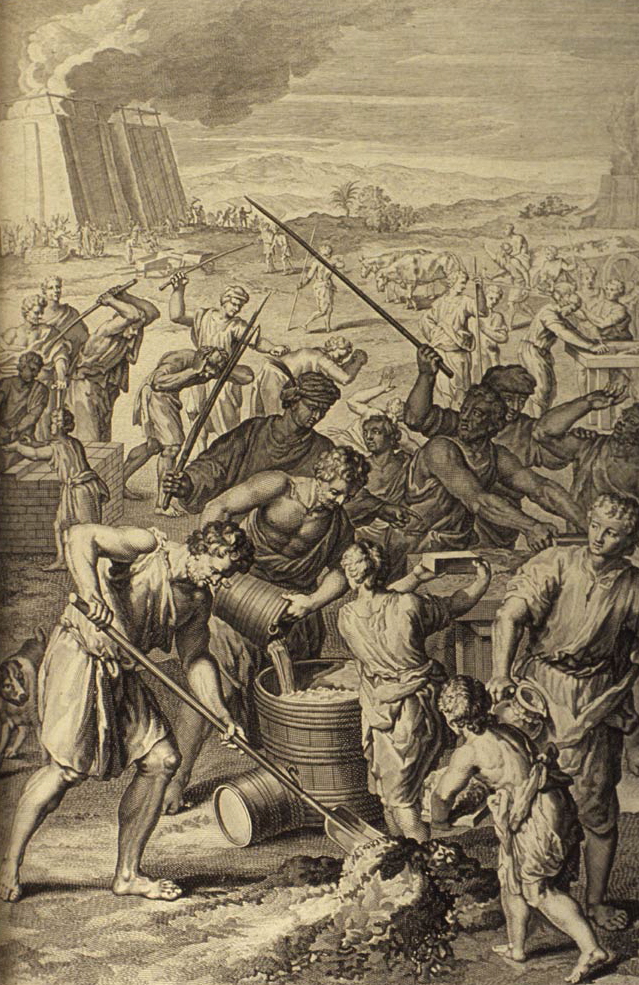
Figures_The_Israelites'_Cruel_Bondage_in_Egypt

The Israelites’ Cruel Bondage in Egypt, by Gerard Hoet (1648–1733)

Exploiting areas of moral overlap between the bible and contemporary culture is always a good principle. Contemporary America is essentially a culture-in-transition, so there’s a lot of ambiguity present in our national consciousness, but there’s plenty there to be taken advantage of.

It’s common to read melodramatic laments from the John Hagees and Robert Jeffresses of the world about how far America has drifted from Christian principles it used to cohere to. In reality, there was a time when our nation’s basic moral framework overlapped with the moral vision of the Christian faith in certain areas and not so much in others. We came to hold those areas of overlap very dearly and ignore the areas where the American moral framework fell dreadfully short of the biblical worldview.

But much of the angst that American Christians feel today about the nation’s supposed drift away from biblical values is actually a misplaced panic at the fact that the cultural shift we are experiencing is shaking things up so that the specific points of overlap between the American mindset and the biblical mindset are different. Top that off with the fact that America no longer pays institutional lip-service to the Christian religion, and we’ve got a new cultural situation that, although not worse than the one our grandparents grew up with (even in the good ol’ days, America was a kiddie pool of sin), is distinctly different, and we have to engage the culture accordingly.

For example, the contemporary America is not, like the America of yesteryear, consumed to a fault with questions of personal moral piety. Every culture inherits a doctrine of sin even if they do not, strictly speaking, have the necessary vocabulary to identify it. While sin is what it is, because truth isn’t relative, it has been uniquely understood through the ages.

The contemporary American doctrine of sin, if any such monolithic agreement can be clearly identified, is concerned primarily with sinful systemic structures. Never before has Total Depravity been an easier concept to sell. In the last several centuries, our notions about right and wrong have been torn asunder and then stitched back together by Darwin, Derrida, Nietzsche, Heidegger and other heavy-hitters. We’ve watched totalitarian demagogues rise and fall while honest, God-fearing citizens marched along to the rhythm of Apocalypse. We’re not really sure what evil is in the abstract, and we’re not entirely convinced it exists. But rarely do we fail to identify it when it appears in concrete form. There has not previously been a generation more sensitive to the pervasiveness of coercion in human behavior, and the contemporary western doctrine of sin deals extensively in the difficulty associated with preventing coercion without stifling human freedom.

The subtle suspicion that our collective moral convictions are environmentally conditioned has led those with sufficient influence and vested interest in maintaining the ideological status quo to forcefully suppress those who would pose a threat. Society has caught on to this trend and responded by trying to undercut the militarizing influence of moral uncertainty by privatizing convictions. In the absence of a clear-cut pathway to discerning non-partisan truth, we have shifted the emphasis away from conformity to a common moral standard in favor of conformity to a common commitment to “pursu[ing] our desires fairly—that is, in a manner that does not impinge on anyone else’s freedom.” (Quote by Stanley Hauerwas).

But privatized convictions are their own worst enemy. They actually bolster the culture of coercion by undercutting their own commitment to mutual non-coercion. Because the hyper-individualization wrought by contemporary society’s “live-and-let-live” ethic devalues the actual truthfulness of moral convictions we are left with no actual basis on which we can bravely oppose violent coercion. Having been overwhelmed by the pervasive role of power-plays in institutional morality, contemporary people take for granted that no alternative exists. “As a result of our self-deception, we have become unrelentingly manipulative,” Hauerwas laments. Thinkers both religious and secular have sought all the more rigorously a social ethic built atop a “universal” foundation–that is, a non-religious basis for doing right by others. That didn’t work out either.

“The attempt to secure peace through founding morality on rationality itself, or some other “inherent” human characteristic, ironically underwrites coercion, [because] if others refuse to accept my account of “rationality,” it seems within my bounds to force them to be true to their “true” selves.” quoth Hauerwas.

All of this means that we can no longer expect those outside the Christian community to share even the basics of the Judeo-Christian moral framework. This has staggering consequences on efficacy of what had been tried-and-true aspects of gospel preaching. Until recently, the forcible Christianization of the western world remained largely intact. The American consciousness was (to use a term coined by Jonathon Martin),  “Christ-haunted”. As a result, we did not need to define our terms. We could assume that there was, at the very least, a basic agreement about what was and was not kosher. Even those who reveled in debauchery either did so in secret or conceded that the debauchery in which they reveled was indeed debauchery and that they reveled in such debauchery because they were debauched.

The America in whose midst we stand as the Body of Christ, however, is undergoing the probably overdue process of dechristianization and correspondingly the points of contact it does have with the Judeo-Christian ethic are both fewer and different than before. One such example is that while the biblical push toward monogamy is no longer a considered viable in the American consciousness, the Old Testament’s ambivalence toward unregulated economic systems is unprecedentedly welcome. Monogamy is now seen as stifling and probably coercive, but laissez-faire capitalism is no longer accepted uncritically as the paragon of individual freedom. We are more conscious than generations past of the oft-hidden wheels that turn in the background, rendering a wholly autonomous class of big-business figureheads nightmarish for those (read: the labor force) under the thumb of their unmitigated sovereignty.

My own colors will show here (I’m politically conservative and I happen to like Capitalism), but what makes the American experiment work (in theory) is the presence of communities who prophetically push for justice in an arrangement in which the government’s role is not to coerce individuals and businesses into doing right by others. It’s true that there can be no such thing as a morally neutral government, but in a non-invasive arrangement such as the American republic is meant to be, the Church is one example of a community that helps make capitalism possible. There will always be a power struggle. There will always be a coercive sovereign–whether it is the Federal government or the corporation. And the culture is now more acutely aware of this than ever before.

So although the Church and the culture are no longer on the same page regarding sexual ethics (amongst other things), ambivalence about what we might call corporate sovereignty has become a point of convergence between the two. The difference is that our ambivalence is shaped by the Old Testament narrative, which paints a picture of a monarchy whose tumultuous politics gave birth, at points, to economic arrangements that left common folk at the mercy of Pharaohesque employers – a situation roundly condemned by the prophets, perhaps not because they opposed hands-off economic policies (to apply modern economic vocabulary to ancient Near-Eastern culture would be a bit anachronistic) but because no checks-and-balances existed to protect workers from abuse.

Such focal points are the jumping-off points on which we ought to zero in. You can no longer assume that your next door neighbor has a moral commitment to monogamy, but they’re probably appropriately ambivalent about Wall Street cacophony and corporate corruption. They’re probably anxious about systemic forms of injustice – police brutality,  the disproportionality with which minorities are sentenced to death for the same crimes as Caucasians, militaristic Bush-era empire building, etc.: concrete examples of authoritarianism revealing the cracks in its own asphalt. Those who are only now becoming concerned about such issues are, in a sense, finally catching up to the Bible. These are only a few examples.

As in all generations, the Bible ought to direct our gospel proclamation. But the points of convergence between the Bible and the culture are the in-roads by which we effectively witness. And as the culture has changed, so have those points of convergence. Let’s exploit them well.

How To Domesticate a God

GoldCalf

The Adoration of the Golden Calf by Nicolas Poussin.

“Then Jeroboam built Shechem in the hill country of Ephraim and lived there. And he went out from there and built Penuel. And Jeroboam said in his heart, “Now the kingdom will turn back to the house of David. If this people go up to offer sacrifices in the temple of the LORD at Jerusalem, then the heart of this people will turn again to their lord, to Rehoboam king of Judah, and they will kill me and return to Rehoboam king of Judah.” So the king took counsel and made two calves of gold. And he said to the people, “You have gone up to Jerusalem long enough. Behold your gods, O Israel, who brought you up out of the land of Egypt.” 

And he set one in Bethel, and the other he put in Dan. Then this thing became a sin, for the people went as far as Dan to be before one. He also made temples on high places and appointed priests from among all the people, who were not of the Levites. And Jeroboam appointed a feast on the fifteenth day of the eighth month like the feast that was in Judah, and he offered sacrifices on the altar. So he did in Bethel, sacrificing to the calves that he made. And he placed in Bethel the priests of the high places that he had made. 

He went up to the altar that he had made in Bethel on the fifteenth day in the eighth month, in the month that he had devised from his own heart. And he instituted a feast for the people of Israel and went up to the altar to make offerings.” (1 Kings 12:25-33)

The quickest way to domesticate a god is to ‘cast a graven image of their likeness.’

The rationale is simple, actually. When you take after a god, you come to value what that god values. So when Monarchic Israel/Judah took after Ba’al and Jeroboam’s graven calf-idols of Yahweh, their passion for the hungry and destitute fell by the wayside. Because Jeroboam’s version of Yahweh values what Jeroboam values, the Canaanite deity Ba’al and Jeroboam’s Yahweh don’t look so different. As a rule, we conjure up gods whose hearts beat in time with ours.

There is something to the popular suggestion that the gods of human history are just projections of the human psyche. To a point, Bultmann was on the mark in saying that theology is really anthropology. Unbeknownst to him, he’d made a biblically sound suggestion. The Old Testament paints a picture that suggests only two options truly exist: the ‘anthropological’ god of Jeroboam on the one hand – the golden calf whose sheer existence sacrilizes whatever nonsense the king dreams up – and the true God, the Facilitator of the Exodus on the other. We can have a projected god – Jeroboam’s God – who is for us because we are for us and he belongs to us, or we can have a God who is for God, and who, because He is for Himself, is ‘for us’ in a better way than the pliable, relentlessly affirming images we’d graven.

The ‘anthropological’ god of Jeroboam, however appealing, always proves himself a cheap trade-in, because although he is ‘for us’  as we are for us, his vote in our favor is a vote of betrayal, because our self-love is traitorous – not only to the true God who facilitated the Exodus, but also to us. Who lies to us more than we do? Who sabotages our endeavors more than we do? We are constantly acting against our best interests, choosing shallow affirmation over love, low-cost gratification over lasting hope. We are the antagonists in our own stories. Jeroboam’s god, who is for us as we are for us, is fickle because we are fickle. He is only as much of an ally to us as we are enemies to ourselves. He is only as trustworthy as we aren’t. Having a god that is for us is a living nightmare, because it has always proven to entail that he is like us.

In this light, taking on the values of a god who is already for us is a non-action. It is not a conversion, because if the god to whom we conform our values is already on our side we have nothing to surrender. Somewhere beneath our ‘collective consciousness,’ our fealty to the divine suzerain whose image we ourselves cast is an insidious form of circular self-devotion. Our service to Jeroboam’s Yahweh is really just service to our own community’s interests. Fealty to the graven image of the god of Israel proves at last to be something akin to “my country, right or wrong.” Soon enough, Jeroboam’s Yahweh has revealed himself to be a projected self-sanctioning of a return to Pharaohism.

He is impersonal. Unlike the self-serving God who facilitated Israel’s escape from Egypt and Pharaoh’s grip, he has no intrinsic personhood. He only has our personhood, and so he always votes in favor of our status quo. Like the gods of Egypt, he is bound to be the monarch’s lapdog, and therefore our worship of the impersonal Neo-Pharaohite god who advocates with faux-authority for our status quo is really just a sacrilization of our own self-destructive communal desires. Anything other than Yahwism is a form of illegitimate apotheosis [noun: elevation to divine status : deification (Merriam-Webster)]

Conversely, Yahwism [noun: the worship of Yahweh by the ancient Hebrews (Merriam-Webster)] is by nature a catalyst for the radical reorientation of communal values because the God at the heart of it is self-interested and is consequently beholden to nobody’s status quo. He is free to demand change from His subjects because His godhood is not contingent upon their circular self-devotion. Their continued existence is contingent upon His sustenance because He is real. He is the relational ground of being. The Yahweh who brought the Israelites out of Egypt, who forbade them from making a graven image of His likeness, is free to be God, because He is. And Jeroboam’s golden calf is not.


Unworthy Ministers of a Liberating Gospel

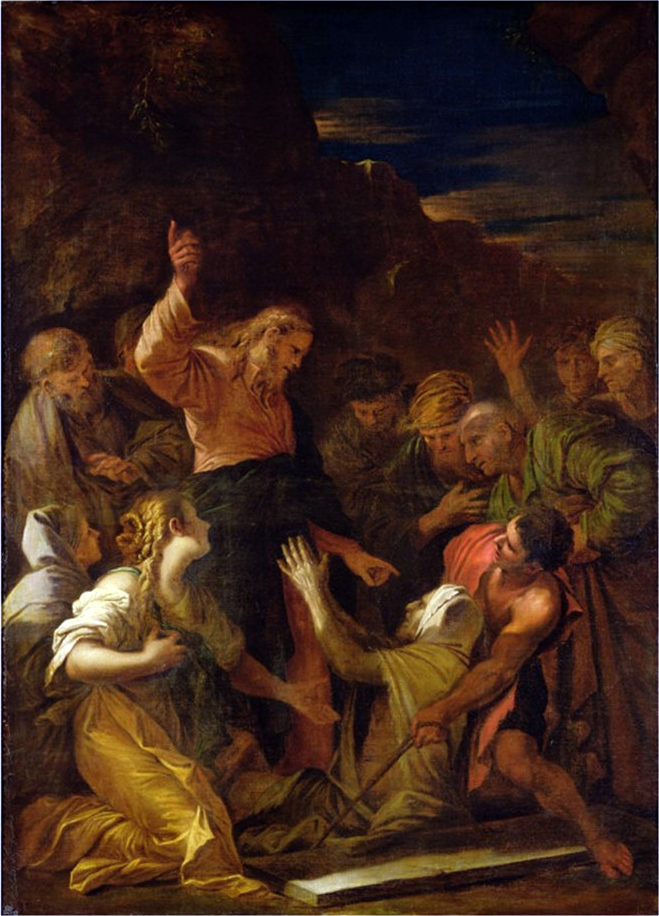
ChristCleansing

Christ cleansing a leper by Jean-Marie Melchior Doze, 1864.

Days come when I wake up in the morning and cannot talk myself into feeling worthy to lead any ministry in any capacity. Weeks of fighting hard against your own sinful habits and tendencies mean next to nothing to you in the hours and the days following a massive, messy collapse. Those are the moments in which you will want to give up – to throw your hands in the air and say, “I’ve always known I wasn’t cut out for this, and here is the proof.”

So you’ll probably do something incredibly unhealthy. If you’re like me, you’ll employ the fake-it-till-you-make-it method of dealing with your own unworthiness. Rather than allowing yourself to feel the weight of your sin and then allowing yourself to be healed by the grace of God, you will suppress both the pangs of crushing guilt and the peace of experiencing God’s ongoing forgiveness. Rather than offering yourself freshly to Jesus, you’ll ‘give God a few days to cool down’. And if you’re in any sort of leadership position in the Church, you’ll put on your best “I’m doing fine” face and carry on doing the work of God without the Spirit’s guidance.

I remember just how messed up I am every time I speak condescendingly to my girlfriend and watch the sense of security with me disappear from her eyes. It is crushing to realize that you are the kind of person that makes others feel unsafe. I remember just how not-holier-than-anybody I am every time I make the conscious decision to take the easy rather than the ethical course of action when nobody is watching. And if the conversations I’ve had with other believers are an accurate representation of the norm, everyone is like me.

Not everybody’s sins are the same, but everybody’s sins are equally crippling. Whether you’re a porn addict or an emotional terrorist or just kind of a jerk, your sins are crippling. And if, like me, you’re tasked with leading others in ministry on a regular basis, the crippling effects of your constant moral failure can eat you alive.

The lie that we believe, that dominates our lives, is that we are uniquely jacked up. Because we can only know other people to a certain degree, it’s an easy lie for the enemy to sell. While I can’t plumb the depths of anyone else’s depravity, I know my own far too well to trust myself with anything. And so it goes with everyone.

But the gospel poses an uncompromising challenge to the pervasive lie. Namely, that everyone, everywhere, is supremely, nauseatingly jacked up. If the Biblical narrative is true, then I can assume with confidence upon meeting anyone that somewhere beneath the human face they put on, a terrifying darkness is present. We just domesticate our actual-jacked-up-ness well. At our best, we are all one push away from collapsing back into utter debauchery.

Let me put it another way. Nobody is that well adjusted. Time and intimacy reveal the cracks in the asphalt of everyone, and all it takes is to look closely at someone for a moment to see how remarkably fragile they are. We have a threadbare righteousness.

That means you don’t have to feel like damaged goods when your actual-jacked-up-ness shows its ugly face. And if you’re someone tasked with leading others as a minister of the gospel, it should remind you that you’re leading a flock of jacked-up redeemed people as one after their own heart. You’re going to sin, and then you’re going to be numb for a while, and then you’re going to be hit like a train with the fact that you’re completely unqualified for the job of “spiritual guru”. In that moment, cling to that conviction. Because it’s true. Your real-life depravity completely disqualifies you from wearing the “spiritual guru” hat. But understand that it’s a joyous disqualification, because ‘spiritual gurus’ have nothing to offer people who are ‘crooked deep down’.

Instead, be a ‘wounded shepherd’, selling a story of good news for criminals like yourself.

Paul and His Co-Authors

Rembrandt_Harmensz._van_Rijn_153

Rembrandt’s Timothy and his grandmother, 1648

While studying 1 Thessalonians for a college class, I was forced to deal with the critical issues regarding the authorship of the two letters to the churches in Thessalonica. The problem is fairly simple. The syntactical differences between the two works are substantial, as is the tone of the two letters, purportedly sent within a fairly short span of time from one another. The imminence of the Jesus’s return seems to be the focus of the first letter (so say those who question the authenticity of the second epistle) whereas the point of the latter appears to be to dissuade the Thessalonians of its imminence, even including a verse that may be an entreaty for the churches in Thessalonica to ignore the first epistle (2 Thess. 2:1-2).

The latter objection is a stretch. It was common for others to send pseudepigraphal letters in the names of the apostles. The early Church fathers were at least as relentless as, if not more than, the critical scholars of the 19th and 20th century in their efforts to snuff out forgeries and pseudepigrapha.  Bishop Serapion of Antioch (d. AD 211) once said “we receive both Peter and the other Apostles as Christ, but pseudepigrapha in their name we reject.” His statement appears to be representative of the sentiments of the early Church. Some of the earliest Church Fathers may have actually known Paul and all of them were immersed in the world into which he wrote. With all of this in mind, 2 Thessalonians went nearly unquestioned until Baur walked on the scene and decided, quite arbitrarily, that only Romans, Galatians, and the two letters to the Corinthians could be confidently called Pauline. The objections involving the supposedly conflicting eschatological visions of the two epistles reflects a weak reading of the Pauline corpus on the part of the Baur school more than any real dissonance between the works.

The dissonance in tone and syntax is not so easily dispensed with. A multitude of explanations have been offered, but the simplest and most probable may be that Paul often did not write alone. The argument goes as such. Paul’s utterly undisputed works consist of Romans, Galatians, and 1 & 2 Corinthians. The rarely disputed works are 1 Thessalonians, Phillipians, and Philemon. The ‘somewhat doubtful’ epistles are Colossians and 2 Thessalonians, the ‘very doubtful’ are Ephesians and the Pastorals. Those considered doubtful are often dispatched on the grounds that they appear to teach a ‘higher’ ecclesiology or have a ‘more developed’ eschatology than those works that are undisputed. This is especially true in the case of 2 Thessalonians.

It is noteworthy that two of the six disputed letters explicitly purport to be ‘from’ Paul and at least one other associate. Colossians names Timothy with Paul in the greeting establishing the sender. It is no stretch to imagine that Timothy was involved in the authorship. Both epistles to the Thessalonians name Silas and Timothy as co-senders. It is again no stretch to assume a shared role in authorship. They are at the very least prime candidates for authorship. Ephesians also merits mention. It does not mention a coauthor in the greeting. However, the greeting itself is suspect on account of the textual variants found within it. The phrase “to the Ephesians” is missing from the earliest manuscripts of the letter, suggesting that it was originally a general letter that was copied and circulated throughout the churches in the Roman Empire. Today, it is known as Ephesians solely on the basis of tradition. Given the uncertainty regarding the greeting, it is possible that the original greeting mentioned a co-sender. Plenty of ink has been spilt on the similarity between Ephesians and Colossians and it could be that both emanate from collaboration between Paul and Timothy.

All of this brings us back to 2 Thessalonians. Without a doubt, the two evangelists had some sort of input in the writing process of both epistles, but only God knows precisely what the input consisted in. If I had to take a guess on the source of the radical departure in tone and style in the second epistle, I would hypothesize that Silas played the primary role in the authorship. Silas seems to have been either a prophet or an exhorter (Acts 15:22), either of which may explain the rather sharp tone of the work in contrast to the warmth of the probably Paul-penned first epistle.

It’s not likely that the “pseudepigrapha” hypothesis is going away anytime soon. Since the early 19th century, it has been the dominant narrative in the field of Pauline studies, and as a result it has been, in a sense, canonized into the orthodoxy of contemporary scholarship. However, if some or many of the letters commonly attributed unilaterally to Paul by conservative scholars are actually the products of collaboration, then much of the basis for the “pseudepigrapha” hypothesis disappears.

Time Isn’t The Key To Evolution, But Design May Be

Destruction_of_Leviathan

“Destruction of Leviathan”. 1865 engraving by Gustave Doré

Historically, the Christian religion has understood the world to be something like the stage upon which the drama of cosmic history plays out. Although there has been a diversity of understanding within Christian tradition regarding the nature of the world, it could be generally summarized by saying that it consists in both physical, observable creatures and objects and spiritual, non-observable creatures and objects. Those things which are physical and observable can be seen either plainly (with the naked eye) or under the proper circumstances (i.e. bacterium, microbes; with the proper equipment). Those things which are spiritual and non-observable can only be seen by being revealed.

The many Christianites have never been ambiguous regarding this matter: God and the world are not one-and-the-same. Although the Biblical worldview posits that God actively engages the world, it is postulated with equal clarity that the Creator is not a creature. Such pantheistic theories of God’s “oneness with the universe” are not only theologically problematic; they are nonsensical. Theism alone, Christian or not, can make sense of the universe. How? The relative orderliness of the universe – now, I said relative orderliness – is unlikely to have been achieved in the approximately 15 billion years since the hypothesized “Big Bang,” and the complex and functional creatures that operate within said world likely would not have formed unguided in the span of the approximately 4 billion years since life began, if I understand correctly. Time isn’t the answer to evolution. Design may be.

The sheer existence of the world demands a catalyst. The Bible itself does not actually teach Creation ex Nihilo (creation out of nothing) with any clarity, but creation ex nihilo is philosophically inevitable, and that means that means that a catalyst is also philosophicaly inevitable. More specifically, the relative orderliness of everything demands that it was a conscious catalyst. Nevertheless, amidst the order is a cruel chaos that pervades every corner of existence. The “problem of evil” doesn’t actually go far enough in diagnosing the depth of the universe’s brokenness. It’s not just that “bad things happen to good people.” The whole machinery of the universe runs on suffering. The balance of the ecosystem is contingent upon the innate violence of the creatures therein. As it is now, the world can only run if things die, and often. This phenomenon is well illustrated in this David Attenborough quote:

“I think of a parasitic worm that is boring into the eye of a boy sitting on the bank of a river in West Africa, that’s going to make him blind. And are you telling me that the God you believe in, who you also say is an all-merciful God, who cares for each one of us individually, are you saying that God created this worm that can live in no other way than in an innocent child’s eyeball? Because that doesn’t seem to me to coincide with a God who’s full of mercy.”

David Attenborough’s reaction to the apparent cruelty of the world is more-or-less universal. The phenomenon grates against a moral sense that is so deeply ingrained in humanity that we cannot think past it. We cannot transcend our sense of morality; we can only think in terms of it. Even those who have sought to develop a philosophical system that negates the objectivity of moral truth claims in order to prevent oppressive coercion do so ought of a perceived moral obligation to prevent oppressive coercion. Hence, given the innate moral sense with which specifically human creatures are endowed, it would seem that our conscious catalyst has an agenda. He is doing something, and the world is the stage on which this something is taking place.

The idea that there exists a conscious catalyst who has an agenda for the world alleviates more-or-less all of the objections brought against macro-evolution by its detractors, both religious and irreligious. That does not mean that macro-evolution is true, and that fact that it does not mean that macro-evolution is true does not, itself, mean that macro-evolution is not true. It only means that theistic evolution, specifically within the context of the Christian faith, is a remarkably coherent system. The problems that plague non-theistic incarnations of macro-evolution do not plague theistic evolution. And the philosophical problems raised by theistic evolution are summarily met when theistic evolution is coupled with a specifically Christian worldview.

The relative orderliness of the world ought to be expected given the Christian doctrine of design. The cruel chaos that pervades the evolutionary process ought to be expected given the Christian doctrine of the Fall. Moreover, the meta-narrative of macro-evolution is rendered meaningful, because the conscious catalyst’s agenda means that the cruelty of existence is not the result of nature’s indifference but of creation’s rebellion, it is what Ancient Near-Eastern mythology referred to as Leviathon, which the catalyst Himself has entered into history as a Jewish carpenter to reconcile to Himself.

Paul of Tarsus vs. Jesus of Nazareth?

Bartolomeo_Montagna_-_Saint_Paul_-_Google_Art_Project

Saint Paul by Bartolomeo Montagna, 1481

It’s been in vogue for the last 300 years to say that Paul crafted his own Jesus and used Him as a springboard for His own essentially Platonic philosophy. The argument goes that Paul, good Hellenistic Jew that he was, was influenced by Gnostic Redeemer myths. Rudolf Bultmann, who is a contender for the most-influential-theologian-of-the-20th-century title, was 50 shades of convinced. Today, however, this idea is losing ground as we struggle to actually locate specific examples of the elusive gnostic redeemer myths. But even as the academic community leaves behind the Gnostic-influence theory, the assumption that Paul distorted the original message of Jesus in order to turn Him into a cult god refuses to die. Scholars who hold this position draw a divide between “the Jesus of History” and the “Christ of faith.” The former was the poor and itinerant preacher/carpenter who left everything to preach an apocalyptic message to the poor in Palestine. The latter is essentially a Pauline invention that grafts outside ideas onto the Jesus character and adds depth and clarity to what Paul claimed was the meaning of His life, death, and purported resurrection.

Findings by E. Earle Ellis have made that a profoundly unlikely scenario. Ellis identified pre-Pauline creedal material embedded within numerous Apostolic writings. Notably, nearly all of Paul’s epistles contain some form of quotation from what is presumably an early hymn, creed, or prophecy. These quotations contain material that paint Jesus in the kind of exalted light that scholars often attribute to the creative additions of Paul, but which inevitably emanate from a tradition that pre-dates Paul. To illustrate, I have stitched together several of these pre-Pauline creedal quotations found in the Pastoral Epistles* to reconstruct what one of the early creeds might have looked like:

“Jesus Christ came into the world to save sinners.
He is the blessed and only sovereign,
The King of kings,
The Lord of lords,
The only one who has immortality,
Dwelling in unapproachable light;
No one has seen or can see Him,
To Him be honor and eternal might.
But when the goodness of God and His love for mankind appeared,
He saved us —
Not by works of righteous that we had done,
But according to His mercy,
Through the washing of regeneration
And renewal by the Holy Spirit.
He poured out this Spirit on us abundantly
Through Jesus Christ our savior,
So that having been justified by His grace,
We may become heirs with the hope of eternal life.
For if we have died with Him,
We will also live with Him;
If we endure, we will also reign with Him;
If we deny Him, He will also deny us;
If we are faithless, He remains faithful,
For He cannot deny Himself.
For there is one God,
And one mediator between God and humanity,
Christ Jesus, Himself human,
Who gave Himself — a ransom for all,
A testimony at the proper time.
Amen.”

What makes these findings significant is that they render much of the speculation about Paul’s role in the development of early Christian theology obsolete. Far from ‘inventing’ a whole slew of new ideas, he largely worked with the faith that he himself inherited from the earliest believers. It also demonstrates that the first century Christians were not so ‘primitive’ after all.

With this in mind, we’re in a good place to (finally) call the oft-purported chasm between Pauline-soteriological thought and Jesus’s ethical and eschatological teaching into question. Free from the modern orthodoxy’s insistence that Paul and Jesus taught competing worldviews, it quickly becomes apparent that, despite contrary claims by some, Paul and Jesus aren’t so different.

Not least among their similarities is that their teachings are often hyper-existentialized at the expense of preserving their common ethical commission. Bultmann and others helped to set this precedent, which ironically Evangelicalism now keeps alive. Whether it’s reducing repentance to feeling bad about sinning or reinterpreting the Sermon on the Mount as ‘high ideals’ to live up to, it has often been the case that western Evangelicals in the last few centuries have blunted the transformative force of the New Testament proclamation.

Baptist Ethicist Glen Stassen spent decades calling for a “thicker Jesus” amongst his Evangelical colleagues and brethren. It should come as no surprise, because the bulk of his research was oriented around the Sermon on the Mount. His work delves deeply into the radical social significance of Jesus’s life and teaching, and, in doing so, illustrates the heavy continuity between the life of Jesus and the ministry of Paul. Over against the disintegrating tendencies of both conservative and liberal scholars who hold the two at arms length, good hermeneutics (and faithful obedience to Jesus) demands that we recouple the two central voices of the New Testament. And that means that, in addition to Glen Stassen’s thicker Jesus, we need a thicker Paul.

And we’re in luck. Because as we are forced to lean into Paul more deeply and more sustainedly than before, we inevitably find that he only actually makes any sense in light of the life and teaching of Jesus. It is common and correct to read his work from the vantage point of Jesus’s death and resurrection, as Bultmann advocates. But it is incomplete to do only that. Every bit as much as Paul writes out of the overflow of the resurrection of Christ, he writes in the footsteps of His teaching and in imitation of His life. John Dominic Crossan once said, “If you read Jesus after reading Paul, you’ll read Jesus wrong. But if you read Paul after reading Jesus, you’ll read Paul differently.” I’m certain that Crossan would say that I read both Jesus and Paul wrong, but his point stands. The more deeply we entrench ourselves in the Gospel recollections of Jesus’s pre-Passion ministry, the more clearly we are able to hear Paul speaking. It is true that Paul can often be confusing. I say that in the company of his friend and occasional sparring partner, Peter (2 Pet. 3:16). But from the vantage point of the life and teaching and cross/resurrection of Jesus, Paul often speaks quite plainly.

For example, upon a close reading of his epistle to the Romans, it becomes clear that Paul had more in mind when writing the iconic epistle than simply imparting doctrinal knowledge. Evidently, his motivation was largely to repair the fragile and strained relations between the Jewish and Gentile believers in Rome and, by extension, throughout the Empire. He therefore crafts his entire theological argument around the movements of Israel’s history in such a way that God’s redemptive intentions toward the Gentiles is front and center – and in doing so, he illustrates that the unity between the two bodies is the inevitable outworking of God’s cosmic redemption. In the most immediate sense, he hoped to include the predominately Gentile Churches of Rome in the collection that he was taking up for the impoverished and persecuted churches in Jerusalem—most of whom were predominately Jewish. Paul was here putting a transforming initiative of Jesus into practice as a means of reconciliation in the Church. He seems to have been working off of Luke 14:12-14:

“He said also to the man who had invited him, ‘When you give a dinner or a banquet, do not invite your friends or your brothers or your relatives or rich neighbors, lest they also invite you in return and you be repaid. But when you give a feast, invite the poor, the crippled, the lame, the blind, and you will be blessed, because they cannot repay you. For you will be repaid at the resurrection of the just.'”

By indebting the Jewish churches—who largely looked down on their Gentile brothers and sisters—Paul would kick open the door for the Holy Spirit who indwelt both parties to smash the pretensions of the Jewish believers toward their Gentile brothers benefactors. Through including the Gentile believers in an act of holy love toward their Jewish brothers and sisters, Paul would make space for the Holy Spirit to fill them with the sort of love it requires for two groups who have long been in contention to be brought together under a common Messiah and in a common Spirit. This is only one example, but once you catch one, you begin to see them everywhere.

Given both a thicker Jesus and a Thicker Paul, the exegetical obstacles that have frozen New Testament scholarship in awkward limbo for centuries begin to melt away. In retrospect, there isn’t much of a dichotomy to be found between the “Jesus of history” and the “Christ of faith.” But there are certainly irreconcilable differences between the Jesus-soaked Paul of history and the neo-Platonist Paul that emerged in the writings of the post-Schleiermacher scholars. What we’re facing is not struggle between theological conservatism and theological liberalism, but a failure on the part of both conservative and liberal New Testament scholars to adequately synthesize the non-competing teachings found within the epistles of Paul and the canonical  Jesus tradition of the four gospels. When approached honestly, it is apparent that Paul of Tarsus only really makes sense in light of Jesus of Nazareth. Paul did not hijack Jesus in order to build a theology; Paul was hijacked by Jesus in order to build a Church.


*Note: The Pastoral Epistles consist of 1 & 2 Timothy and Titus. I am aware that they are often assumed to be inauthentic by scholars both conservative and liberal for a number of reasons. However, the arguments for their inauthenticity are bad. Like, really bad. I’m willing to bet that within a decade or so, we’ll have outgrown the notion that somebody else forged the documents in Paul’s name. I’ll probably write about this in the near future.

Humans Are Seekers, Not Survivors

Tour_de_babel

Tower of Babel, by Lucas van Valckenborch, 1594, Louvre Museum

Human history is haunted by variegated expressions of religious faith, which is fascinating. To the best of our knowledge, humans are unique in the universe inasmuch as we are genuinely sentient. We have the capacity to make moral decisions both as individuals and as communities that are not fundamentally oriented around the survival of our species. Of course the macroevolutionary model is true, but it’s also the case that we operate on terms irreconcilable with a purely materialistic understanding of the evolutionary process. We are not chiefly survivors; we are chiefly seekers.

The Austrian-Jewish neurologist and psychotherapist Viktor Frankl, a Holocaust survivor, devoted his post-WWII years to popularizing his theory that, rather than survival (as some Darwinists might have taught) or pleasure (as some Freudians certainly taught), meaning was the dominant pursuit of mankind. He argued that the search for meaning unconsciously motivates the decisions that we make, from Abraham’s desire for children to Jacob’s desire for blessing, to Paul’s desire for redemption.

Reductive though it may be, it is a helpful paradigm. Whatever we are, we are not merely the next step in the evolutionary meta-narrative (and it is a meta-narrative). We are creatures who seek out meaning and find it in places where it may or may not exist. Inevitably, then, we are creatures who seek God. Not only do we seek Him where He is (e.g. Noah, and Enoch), we also seek Him where He isn’t (“Claiming to be wise, they became fools, and exchanged the glory of the immortal God for images resembling mortal man and birds and animals and creeping things.” Rom. 1:22-23).

As far as I know, chimpanzees, who share approximately 98% of our DNA, are neither religious nor superstitious. Something is abnormal about humanity, and it probably comes down to more than simply something maverick in that remaining 2%. Plenty of theories have been put forth to explain them, and they’re not boring. But they’re also not terribly convincing. The various secular attempts to account for mankind’s insatiable religious bent are no more persuasive than the hypothesis, put forward by all cultures everywhere until relatively recently, that humanity was created by a personal being (or beings) who intends to have a relationship of sorts with us.

I’m a big fan of Yann Martel’s book Life of Pi. I originally read it as a freshman in high school, about a year before becoming a Christian. And I totally didn’t get it. On this side of the faith line, it’s much more resonant, and it provides about as good an apologetic as can be made for the existence of the divine. Granted, there is plenty to be said for classical apologetics. Despite the impassioned “Nuh-uhs” of the New Atheists, the Cosmological argument really, really is weighty. As are most of the arguments that occupy the arsenal of the average apologist.

But as a human on planet earth, living a life that takes place chiefly outside of an office with a desk, Martel’s “story to make you believe in God” really is all that. In the book, the narrator tells two stories, both of which bring about the same conclusion by all empirical evidences. One features his narrator surviving 277 days at sea on a life raft with a hungry Bengal tiger named Richard Parker, stumbling onto a “a floating island network of carnivorous algae,” and crossing paths with a cannibalistic survivor from another shipwreck. The second story has none of the more fantastical elements. He then poses the question: with both stories satisfying the empirical data, which was the better story?

It is conceivable that humanity’s seeker bent is somehow conducive to our flourishing as a species. But it’s equally conceivable, and bloody well more intuitive, that something more is at play.

God Gets His Hands Dirty

Martin,_John_-_The_Seventh_Plague_-_1823

The Seventh Plague: John Martin’s painting of the plague of hail and fire (1823)

“Then the Lord said to Moses and Aaron, When Pharaoh says to you, ‘Prove yourselves by working a miracle,’ then you shall say to Aaron, ‘Take your staff and cast it down before Pharaoh, that it may become a serpent.'”  So Moses and Aaron went to Pharaoh and did just as the Lord commanded. Aaron cast down his staff before Pharaoh and his servants, and it became a serpent. Then Pharaoh summoned the wise men, and the sorcerers, and they, the magicians of Egypt, also did the same by their secret arts. For each man cast down his staff, and they became serpents. But Aaron’s staff swallowed up their staffs. Still, Pharaoh’s heart was hardened, and he would not listen to them, as the Lord had said.” (Exodus 7: 8-13)

A consistent, though rarely dealt with, theme throughout the Pentateuch  is that, for the sake of redemption, God gets His hands dirty.

The Hebrew scholars tell me that the word used for ‘serpent’ in this passage is tannin, which is interesting because it differs from the word nachash used in Exodus 4:2-5 when God initially explains the signs to Moses. The significance lies in the connotations that each of the terms carry. Nachash is the term used in Genesis 3:1 in reference to the serpent in the Garden of Eden. Tannin, on the other hand, was more commonly used in reference to the sea monsters that pervaded ancient Canaanite, Phoenician, and Hebrew mythology. More specifically, the sea dwelling tannin were (generally) understood as the creaturely personification of chaos and evil.

Aaron’s staff is turned into a serpent (tannin), a feat that is then copied by Pharaoh’s magicians, and the serpent (tannin) that God produced out of Aaron’s staff devours the serpent (tannin) produced by the magicians. If the tannin described in this passage elsewhere refers almost universally to the anti-creational forces of chaos that oppose the rule of God, then it’s unlikely that the passage at hand is an exception. The initial showdown described in Exodus 7:8-13 is not, theologian Peter Enns has pointed out, merely a showdown between Pharaoh and Moses/Aaron. Nor is it a showdown between Pharaoh and Israel. At one level, it is a showdown between Pharaoh and Yahweh. But even that is too myopic a reading. What we witness in this passage is foreshadowing of the drama that will ensue throughout the rest of the Pentateuch, and the rest of the Biblical narrative as a whole: the Creator of the universe overcomes the chaotic forces of darkness (tannin) that have usurped the world on their own terms. He will overcome tannin, sometimes, inevitably, by employing tannin.

God is not Deistically removed from the plight of creation, looking down in stoic disapproval at the mess we’ve made; He is Theistically active in the redemption of creation, to the point that He will work within the bounds of the fallenness of the world to rescue it. Hence, God will spill blood in the process of bringing about the end of blood-spilling. God will bring about an end to human violence, sometimes, inevitably, through Divine violence. Throughout the scriptures, and especially the Old Testament, God wears the warrior hat, not because He is fond of violence, but because He is bringing about its end. In the pages of the Torah we watch Yahweh crush a thousand Pharaohs in order that one day the may never be another Lamech. (Gen. 4:23-24)

That is why the satisfied God, who created all things to share in His own satisfaction, will enact plagues on Egypt (Ex. 7:14-11:10, 12:29-32): in order to further His redemptive operation. It is true that Egypt was met with the consequences of their communal oppression of the Israelites. But at a more foundational level, God’s act of vengeance on Egypt was driven by His love for the world – a love that moved Him to get His hands dirty. I’m about to cross the line with some people’s patience here: this is why the same God revealed in Jesus Christ (Col. 1:15; John 1:18; Heb. 1:3), the God who is Love (1 John 4:8,16), ordered the slaughtering of the Canaanites and others (Deut. 20:17; Josh. 6:21). This is why the God who “desires that all would repent and be saved” (1 Tim. 2:4; 2 Pet. 3:9) would harden the heart of Pharaoh and bring him to his knees (Ex. 11:8-10).

The horrific violence performed and sanctioned by God throughout the biblical narrative, far from being a break from character, emanates from His own faithfulness to His promise to bring about redemption to a sin-shattered world. It is, in fact, a deeper, warmer love than is intelligible to us that prevents Yahweh from being deterred from His project of reconciling the world to Himself by His own innate desire to preserve the lives of those who would prevent Him. In the endeavor to bring about a kingdom that operates on love, He cannot tolerate those who persist in hate. What the story of the Torah teaches us, amongst other things, is that God so loved the world that He was willing to work within the bounds of its fallenness to rescue it.

Servantlike Images of a Self-Exalting God

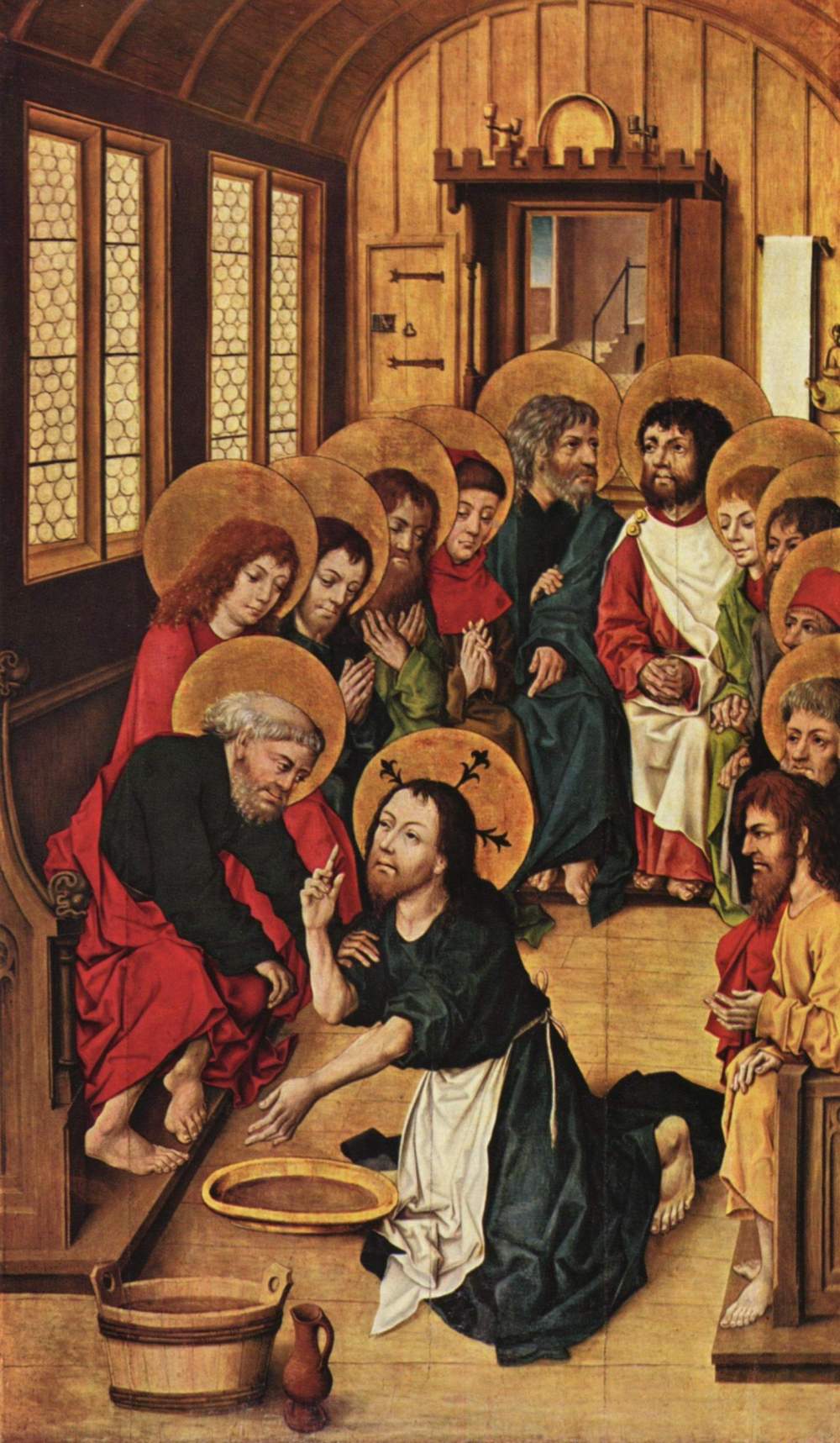
Meister_des_Hausbuches_003

Christ Washing the Feet of the Apostles by Meister des Hausbuches, 1475 (Gemäldegalerie, Berlin)

“And they came to Capernaum. And when they were in the house, Jesus said, “What were you talking about on the way?” But they kept silent, for on the way they had argued about who was the greatest. And He sat down and called the twelve. And He said to them, “Anyone who would be first must be last of all and servant of all.” And He took took a child and put Him in the midst of them. And taking him in His arms, He said, “Whoever receives one such child in My name receives Me, and whoever receives Me receives not Me but Him who sent Me.” (Mark 9:33-37)

“If anyone would be first, he must be servant of all.” The question we have to ask ourselves when we want to be godly bosses, godly parents, godly pastors and godly professors is, “How can I be a servant to those over whom I have ‘authority’?” Jesus came as a servant, and He never met a person He didn’t serve. Even the religious leaders who met harsh reprimand from Him were served in the process. No one else was willing to call them to repentance, save for the recklessly self-marginalizing Essene cult, whose reprimand resonated only with fringe wilderness dwellers. There is nothing inherently unloving about issuing rebuke. It is only selfish rebuke, served out of unholy fire, with little concern for the propriety of the context in which it is issued, that is unservantlike.

Even if we are not leaders in any capacity, if we are faces in a crowd, we are called to the joy of being everyone’s servant. We aren’t called to be doormats. Jesus was everyone’s servant and nobody’s doormat. There’s a difference. A servant is constantly posing the question: “What is the most loving thing that I can do for this person in this situation, given these circumstances?” Becoming someone’s doormat is never loving because in doing so you are only helping them to become more of a monster. Being a servant in the way that Jesus was a servant means being bold and assertive, although never overbearing or coercive. It means loving yourself so you have a reference point on how to love your neighbor as yourself. It means respecting yourself so that you have a frame of reference from which you can understand what kind of respect to give other people.

Being a servant like Jesus means resisting the temptation toward laziness or idleness because there is always someone to serve.  As a husband it means taking every opportunity to give your wife a chance to rest from the rush of the day. It means doing the dishes so that she can watch television, or take a nap, or read a book (or whatever). As a father it means playing with your kids when you’re exhausted from the day, and trying to create opportunities for them to build a good life for themselves in the future. It means doing what you need to do to prevent burnout. If that means waking up early to spend time alone to recharge, do that. If it’s something else, do that. It means stirring your affections for your wife by reflecting on her best qualities and choosing to dwell on them.

If you’re aggressively introverted–like myself–it means sacrificing solitude to be with your friends and family. It also means protecting your time alone so that you’re in a position to treat people well and engage in friendship with them.

We are citizens of a kingdom where everyone serves everyone. At one level, our lifestyle of servanthood is a walking apologetic for the truth of Christ to a world ruled by self-interest. We are called to this life style in order to display the selfless love of the self-exalting God. How does that work? The gospel begins with a Trinitarian God, fully satisfied in the bounds of His own intrinsically communal existence, creating a world of creatures to be servants, lovers, friends–communitarians. He created a people with the end in mind of shaping them to become like Him. That doesn’t mean that we are meant to become gods, but that we are meant to become a community of mutual servanthood.

That God is passionate about being glorified is a given because He is intrinsically glorious, and the intrinsic glory that He embodies demands redamancy from all creatures who encounter it. But with that reality in mind, it is necessary to situate our theology in the simultaneous reality that the intrinsically glorious God whose glory demands worship is also intrinsically satisfied. He has no needs that are unmet within Himself. It is not simply because He “owns the cattle on 1000 hills”, but that any and all conceivable needs that a person might have are satisfied fully by the perfect community that He experiences between the persons of Himself.

That means that when He created people, animals, greenery–everything–He did so with no designs of seeing a personal emotional deficit filled. He did not create us to be loved but to give love. He did not create us so that we might satisfy His emotional needs, but in order to multiply His own satisfaction to a whole world of creatures. The self-exalting God is selfless because His glory is self-authenticating. He can put real weight behind His claims to love people because He has nothing to gain from dying for them. He is self-exalting because He bloody well ought to be.

Jesus modeled this servant lifestyle to us and called us to do likewise because we have been newly created by the gospel to be servants after God’s own heart and Jesus’s own example. The servant lifestyle to which we are called is not only an apologetic to a lost world; it is written into the DNA of our identity in Christ.