Should Christians Meditate?
Here’s a great blog post from a friend of mine (who is also an INFP).
Here’s a great blog post from a friend of mine (who is also an INFP).

Creation on the exterior shutters of Hieronymus Bosch’s triptych The Garden of Earthly Delights (1480–90)
“Look again at this dot. That’s here. That’s home. That’s us. On it everyone you love, everyone you know, everyone you ever heard of, every human being who ever was, lived out their lives. The aggregate of our joy and suffering, thousands of confident religions, ideologies, and economic doctrines, every hunter and forager, every hero and coward, every creator and destroyer of civilization, every king and peasant, every young couple in love, every mother and father, hopeful child, inventor and explorer, every teacher of morals, every corrupt politician, every “superstar,” every “supreme leader,” every saint and sinner in the history of our species lived there-on a mote of dust suspended in a sunbeam.
The Earth is a very small stage in a vast cosmic arena. Think of the endless cruelties visited by the inhabitants of one corner of this pixel on the scarcely distinguishable inhabitants of some other corner, how frequent their misunderstandings, how eager they are to kill one another, how fervent their hatreds. Think of the rivers of blood spilled by all those generals and emperors so that, in glory and triumph, they could become the momentary masters of a fraction of a dot.
Our posturings, our imagined self-importance, the delusion that we have some privileged position in the Universe, are challenged by this point of pale light. Our planet is a lonely speck in the great enveloping cosmic dark. In our obscurity, in all this vastness, there is no hint that help will come from elsewhere to save us from ourselves.
The Earth is the only world known so far to harbor life. There is nowhere else, at least in the near future, to which our species could migrate. Visit, yes. Settle, not yet. Like it or not, for the moment the Earth is where we make our stand.
It has been said that astronomy is a humbling and character-building experience. There is perhaps no better demonstration of the folly of human conceits than this distant image of our tiny world. To me, it underscores our responsibility to deal more kindly with one another, and to preserve and cherish the pale blue dot, the only home we’ve ever known.”
-Carl Sagan, Pale Blue Dot: A Vision of the Human Future in Space

“And when they came to the disciples, they saw a great crowd around them, and scribes arguing with them. And immediately all the crowd, when they saw him, were greatly amazed and ran up to him and greeted him. And he asked them, ‘What are you arguing about with them?’ And someone from the crowd answered him, ‘Teacher, I brought my son to you, for he has a spirit that makes him mute. And whenever it seizes him, it throws him down, and he foams and grinds his teeth and becomes rigid. So I asked your disciples to cast it out, and they were not able.’ … And Jesus asked his father, ‘How long has this been happening to him?’ And he said, ‘From childhood. And it has often cast him into fire and into water, to destroy him. But if you can do anything, have compassion on us and help us.’ And Jesus said to him, ‘‘If you can’! All things are possible for one who believes.’ Immediately the father of the child cried out and said, ‘I believe; help my unbelief!’ And when Jesus saw that a crowd came running together, he rebuked the unclean spirit, saying to it, ‘You mute and deaf spirit, I command you, come out of him and never enter him again.’ And after crying out and convulsing him terribly, it came out, and the boy was like a corpse, so that most of them said, ‘He is dead.’ But Jesus took him by the hand and lifted him up, and he arose. And when he had entered the house, his disciples asked him privately, ‘Why could we not cast it out?’ And he said to them, ‘This kind cannot be driven out by anything but prayer.'” (Mark 9:14-29)
“This kind cannot be driven out by anything but prayer” means that there are no magic Jesus powers. His healing ministry was not from His own power. He was not a magician. Contrary to popular misconceptions that assume that Jesus came to earth as some sort of Superhuman, Mark finds it very important to show us that Jesus’s miraculous exploits were the product of His being in step with the Holy Spirit through prayer. It is essential to historic Christian theology that when God the Son came to earth, He did so without any special advantages. He was a regular Jew with a 9 to 5 and a mom. All of the miraculous feats He performed, all of the counter-cultural teaching that He espoused, His supernatural compassion and concern for the outcast, His boldness, were all the product of His submission to and communion with God the Spirit, who indwelt Him.
This is important to grasp, in no small part because it clears the confusion that Jesus stirs up when He says to the original gathered Church, “Very truly I tell you, whoever believes in me will do the works I have been doing, and they will do even greater things than these, because I am going to the Father.” (John 14:12) He really meant that we would do more than He did, not because we would be more powerful, but because as the Church multiplies and lost sinners are transformed into Spirit-filled believers, the ministry of Jesus itself multiplies and expands. Before His crucifixion, there was one Jesus who made disciples and incarnated the kingdom of God in the midst of a broken world. Today, 2000 years after His resurrection, it is as though there are approximately 2.2 billion Jesuses walking the earth.
“This kind cannot be driven out by anything but prayer” also means that our ability to do anything spiritual, be it cast out demons (yeah, that actually happens), win souls for Christ, or overcome the darkness in us, comes from helpless dependence on God. We are not prayer warriors; the Holy Spirit is a prayer warrior. When we pray for ourselves, whether it’s for a greater love for the Father, a greater freedom from sin, a more obedient heart, etc., we are echoing the Holy Spirit’s earnest prayers on our behalf (Rom. 8:23, 26-27). Jesus walked in utter dependence on the Holy Spirit’s guidance as an incarnated human. We are no less dependent now that He indwells us. Every Christian believes in the Holy Spirit, but ‘believing’ in Him in any meaningful sense means living in a ‘dethroning’ submission to His lead. The person who believes in the Holy Spirit is always in prayer to seek His guidance. She is always communing with Him in prayer to know the Father more intimately. She is always laying down what remains of her stubborn will in prayer to let Him mold her into the image of Christ.
“This kind cannot be driven out by anything but prayer” because we can only “do greater things than these” as people who are pathetic, weak, and like Jesus, are desperately dependent on the Spirit of God to enable us to find and carry out the will of God.
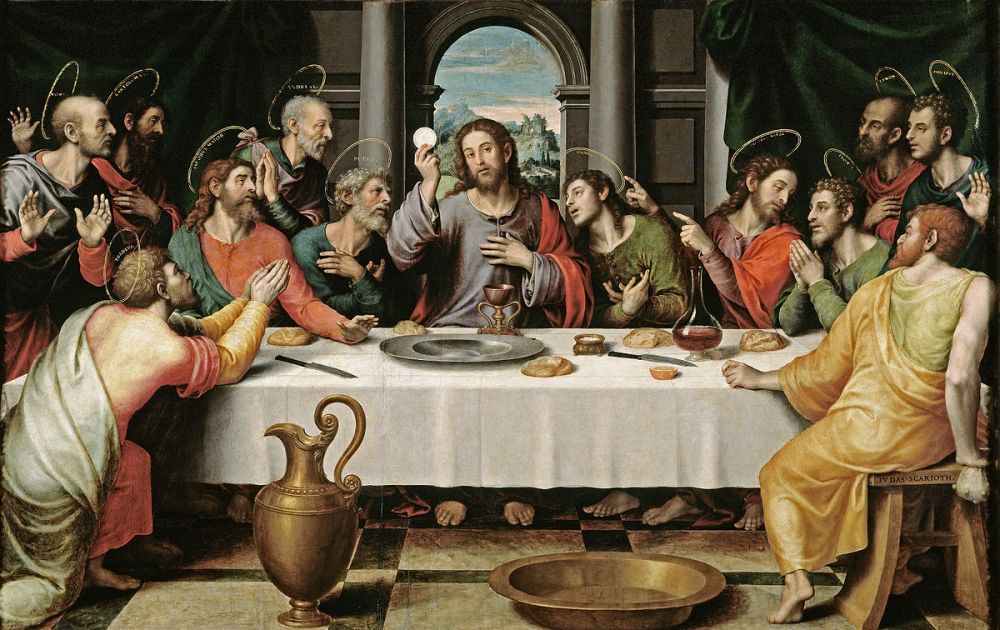 The Last Supper by Juan de Joanes
“Much of what passes for koinonia (“community”) in contemporary church life seems to neglect the fact that the primary goal is not vulnerability or gut-sharing or even friendship, though all these are laudable. The goal is not even to advance eachother’s knowledge of the scriptures, though that too is commendable. These are all secondary to helping one another to know the crucified Christ more intimately. The ultimate goal of koinonia is to discover common life in Christ, common union with Christ, common worshipful adoration of Christ, common soul-orientation toward Christ and our neighbor. For this reason when the gatherings that constituted koinonia are further elaborated in Acts 2, a key element is that “they broke bread in their homes” (Acts 2:46). Its orientation was around the Eucharist, which was celebrated in these days in the context of a love meal.” (Ross Hastings, Missional…
View original post 1,172 more words
 Christ and the Woman Taken in Adultery by Rembrandt
All who held stones,
heavy, thirsty after blood,
felt well that it was time to depart–
dropped what treasure lay
sinister in their grip.
Ashamed at what?
God knows.
Set forth to where?
Even God knoweth not.
Moved incurably by one statement
no one should even make sense of:
“He who is sinless among you,
let him be the first to throw a stone upon her,”
a non-sequitur, to be honest.
Is she less guilty if the high priest has a penchant for buggery?
But all the men with their girded up loins
knelt low, from humility or necessity,
(who knows? What even became of them?)
picking up their cloaks to return to their wives
till only one remained,
one without sin
whose rage might be bottomless,
as far as she knows,
that temptress, or devil, or victim, or kid.
There…
View original post 108 more words
 The Incredulity of Saint Thomas by Caravaggio
I am not God. That is ultimate reality. But only because it contains so much in so few words. “I am not God,” means that God exists. I can reason my way into an explanation for the universe that does not require a creator, but that isn’t the point. God is present in the statements, “God does not exist,” and “There is no God.” I think that you can commune with God, live with Him and love Him with the best part of yourself if you struggle and even fail to believe with your head and your gut that He is real.
The Christian religion recognizes the contradictions in man. We believe, and walk against the grain of our defining beliefs. God promises rest to people who need it. The God revealed in Jesus, who is Jesus, invites one and all to His table…
View original post 530 more words
 Feeding the multitudes by Bernardo Strozzi
“Now [the disciples] had forgotten to bring bread, and they had only one loaf with them in the boat. And [Jesus] cautioned them, saying, “beware of the leaven of the Pharisees and the leaven of Herod.” And they began discussing with one another the fact that they had no bread and Jesus, aware of this, said to them, “why are you discussing the fact that you have no bread? Do you not perceive or understand? Are your hearts hardened? Having eyes do you not see or having ears do you not hear? And do you not remember? When I broke the five loaves for the five thousand, how many baskets full of broken pieces did you take up?” And they said to Him, “twelve.” [And He continued,] “and when I broke the seven loaves for the four thousand, how many baskets full of broken…
View original post 731 more words

Burning Bush by Sébastien Bourdon
“Y’know, the internet has kind of jacked us up.” said the sage-like 30-something year old whom I overheard at Starbucks, “People won’t commit to anything anymore. It’s like they think they’ll get a ‘better offer’ at the last minute. You’ll say, ‘Do you wanna meet at McDonald’s sometime and catch up?’ and they’ll be like, ‘That sounds great. So, maybe.'”
Those words hit me like a welcome punch in the mouth. They’re so relevant – for me, at least.
Humans are inclined to be noncommittal with personal relationships. In my experience, it’s because (among other reasons) we believe that there must be something better to be had elsewhere, with someone else, and perhaps for some people, as someone else. As though we’re hanging on for dear life to the idea that our life might be better if only we were connected to a different community, had a different set of obligations, etc.
But it’s a cover. It’s a sneaky sort of blame-shifting technique. And it’s convenient. It gives us a tail to chase that can occupy us for life and get us off the hook from admitting to the fact that our reluctance to grow close to people, to commit to a certain life course, to really live our lives is rooted in the fear that we’re gonna get life wrong.
A lot of people are terrified of real relationships and struggle to make basic life choices. They have trouble committing to any path in particular because they have no idea who they are or what they are doing. They feel as though they have been thrust into adulthood with no real preparation, like somebody signed them up to be a grown up but never bothered to teach them quite what that meant. Most of us have felt the pangs of this, but have struggled to find the words to describe it.
Although I generally try to forget my Junior High years, I have at least one vivid memory from my days as an awkward, pimpled-faced teenager:
The year was 2008, and I was sitting in a certain teacher’s classroom (whose name will be changed to protect the innocent). We were doing a practice TAKS test. Now, or those of you who didn’t grow up in the Republic of Texas, the TAKS test was an end-of-year test that that a lot of kids could take with their eyes closed (I wasn’t one of them) which measured the student body’s comprehension of the core materials for the year. And since state funding for each school was partially tied to their TAKS scores, my school made sure to put us through a couple of grueling practice tests throughout the year before the real thing came around each April.
So I was relaxing at my desk in a classroom filled with students whose last names began with letters that show up early in the alphabet: Ellington…Delgado…Gately…etc. A little timer on Mrs. Cruella Deville’s desk went off, and she told the class to put our bubble sheets into our test booklets and pass them up to take a 5 minute bathroom break. I did not hear this, because I was spaced out, thinking about frisbees or something, and I tucked my bubble sheet and booklet into the small cubby under my desk.
After the break was over, Mrs. Cruella Deville picked up the booklets and began passing them back out to each student. When she had passed out the last booklet, she noticed that my name had not been called.
“Did you not pass your booklet up?” She asked.
“Oh…uh, no.” I replied, a little embarrassed.
She paused for a moment, as though unsure of what to say. She was a sarcastic woman, and generally had a clever quip for each situation. At this moment, however, her wit failed. As she turned around and walked back toward her desk, she said to the whole class, “Have you noticed that when we have to do something as a class, Ryan is always the one doing it wrong?”
The class laughed. I joined, half because I’ll laugh at almost any joke ever (that’s still true today) and half because I figured that I’d rather laugh with them at my own expense than be laughed at. But beneath my happy-go-lucky disposition, her words stuck. Not because I especially valued her input, but because it was something I was used to hearing. All throughout the earlier years of my life, I was told by teachers and other grown-ups that I couldn’t do anything right. Eventually, I started believing it.
And so a pattern sprouted up: nearly every time something I was involved with really began to require me to commit, to lock-in, I would bail. I would keep everything – friends, commitments, goals – at arms length, because I was convinced that if I ever got deep into anything that I would mess it up. I fundamentally believed that I was a screw up.
Now, I’m not recounting this story to have some kind of pity party. The point is this: for the longest time, I was horrified to commit to anything, or anyone, and I thought that I was the only one who lived this way. As far as I could tell, everyone else had their lives together, and that I was the odd one out. But as the years went on I realized that I wasn’t the only person in the world who had let my insecurities run my life – not by a long shot.
I’m an introvert, but I’m your friendly neighborhood introvert, so I have a lot of one-off conversations with people that I meet in coffee shops and bookstores. One thing I try to gather in each of these chance encounters is how does this person see the world? What I’ve found is that although every person that I meet is unique and vibrant, many share one thing in common: terror. Most of the people that I meet seem terrified to be alive. Just the other day, I asked a guy what time it was and you’d think I was interrogating him at gunpoint.
I don’t blame them.
A lot of people, like the guy I quoted at the beginning of this post, blame the internet for my generation’s anti-social, anti-commitment bent. I don’t. I’m not convinced that having all of this technology and information at our fingertips has made us more anti-social and noncommittal; I think it’s given us an outlet to retreat into a “safe” place. A place that isn’t real. A place where nobody judges us, and we can’t mess up our lives. The Facebook versions of us are stable, funny, and safe. Even when the Facebook me ‘can’t even’, he’s doing just fine. Not so for real life.
And it’s in this fear of marching on into the future, this uncertainty of whether we can handle the weight of being present in our own lives as adults, in the messiness of community with other, equally uncertain people, that most folks collapse, and choose to retreat into themselves rather than muster up the courage to be.
Stop looking for a better offer. Take hold of the life that you have, the family you have, the you that you are. Stop looking for an escape route. Commit yourself to be an active participant in the life that is happening around you. Don’t retreat into yourself, or your smart phone, or your books. This is all there is. Reject the urge to sleepwalk through everything. Be present in your own life. “Do not be afraid.”
Just Like Regular Apologetics...Only Beardier
Analysis, images, meta & more, celebrating the surreal horror classic, currently streaming on Shudder
B&S About Movies is owned and operated by Sam Panico. He is the sole proprietor and chief writer. All others are guest contributors.
Bible Commentary for Christian Living™

 INFP Theologian