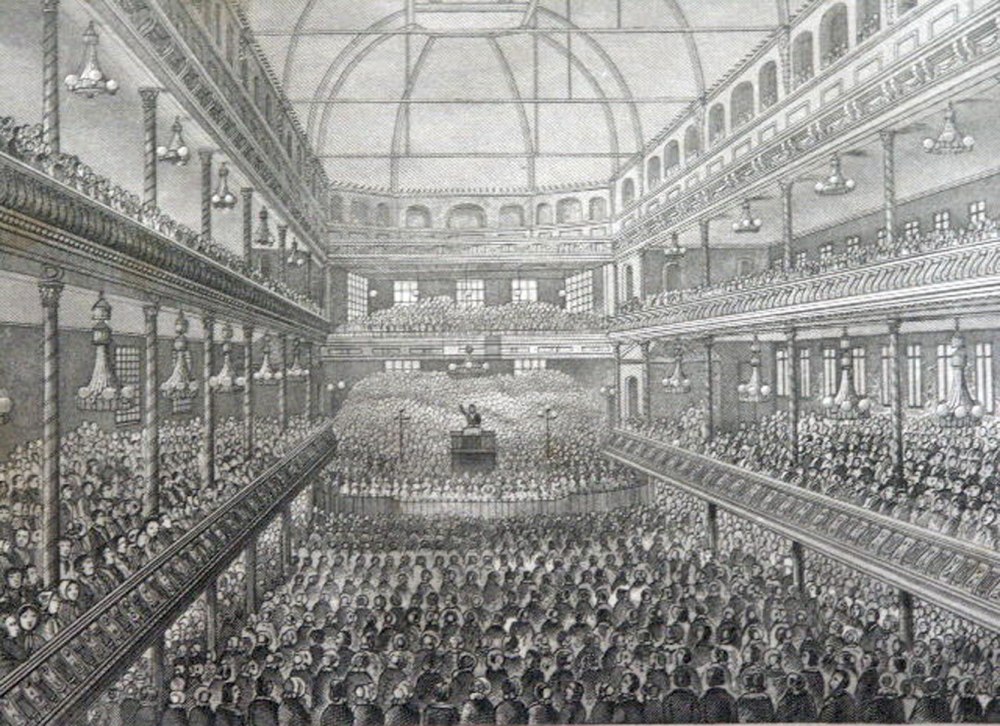
Communion and Social Justice, or, How the Flesh and Blood of Jesus Turn Our Faces Toward the Reformation of Society: A Lay History of a Baptist Giant (Part 3)
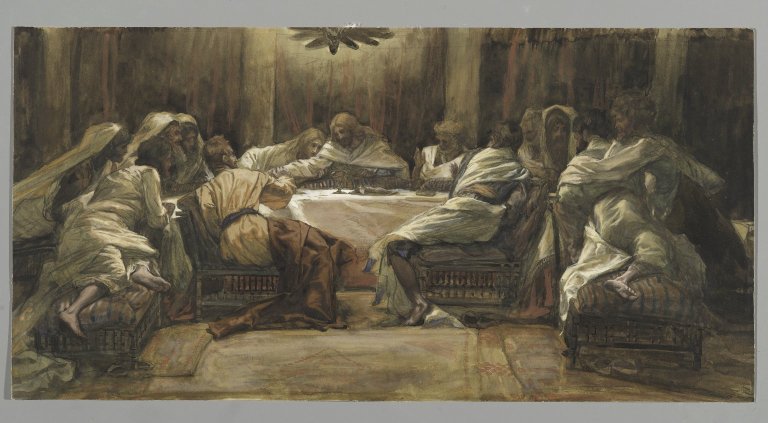
brooklyn_museum_-_the_last_supper_judas_dipping_his_hand_in_the_dish_la_cene-_judas_met_la_main_dans_le_plat_-_james_tissot

Last Supper by James Tissot, between 1886 and 1894.

With a cursory understanding of the backdrop against which the ‘prince of preachers’ conducted his ministry in place, we can make real sense of him. In Spurgeon’s estimation, the established Church in England at the time could be generally characterized as lacking active communion with God – with the notable exception of the fairly small evangelical subsector therein. This was most clearly visible in what he considered to be the dry, mechanical way in which they went about celebrating the ordinance of Communion. He abhorred their practice of reciting pre-written prayers and carrying out elaborate rituals in tandem with the sharing of bread and wine. He once posed the rhetorical question, “can anyone see the slightest resemblance between the Master’s sitting down with the twelve, and the mass of the Roman community?” referring to the Catholic Mass, he appears to have held the same complaint against the ‘tractarians’ and nominalists in the Church of England.

Evangelical churches, as mentioned earlier, had gradually surrendered their identities as the movement lost cultural influence, leaving London in an awkward position. On the one hand, there was a Christless community of ‘whitewashed tombs’; on the other, a lukewarm community who possessed the gospel but were increasingly without unction. The struggles that Victorian Evangelicals were facing were not, in Spurgeon’s mind, because God was not in their midst. He was of the opinion that God had temporarily withdrawn His Spirit from London, and that He was preparing to stir up a revival unlike anything that had been previously seen. But He had no illusions that revival would come about as the result of innovative ministry methods or captivating preaching styles, although he eventually put both to use in service of the kingdom. Spurgeon’s vision for revival was centered on individuals experiencing radical spiritual awakening through communion with God.

This, for Spurgeon, was what Stanley Grenz calls an integrative motif. It is defined as “that concept which serves as the central organizational feature of the [theological] system, that theme around which the systematic theology is structured.” He explains that it is “the heart of the theological system [and] it focuses the issues discussed and illumines the formulations of our responses to these issues.” To name an example, although Martin Luther never produced a volume specially devoted to systematic theology, justification by faith can be clearly identified as the integrative motif in his framework. Likewise, the entire body of John Calvin’s work is oriented around the glory of God and is best understood when read with that motif in view. Friedrich Schleiermacher, to name one more, theologized around the integrative motif of human religious experience. Reading through Spurgeon’s voluminous writings, it becomes clear that experiencing ‘communion with Christ and His people’ was the heart of his theology. Everything that he said and did—his whole body of preaching, his public prayers, his social concern—was born out of that integrative motif.

His theology, then, was a breath of fresh air at a time when the bulk of British Christianity was inconsequential. Although he bought in, at least on the surface level, to the prevailing Self-Help individualism of his day, the heart of his theology was relational. The two aspects of his character proved to be mutually modifying, and the end product was a deep concern for the souls of individuals, for the purpose of seeing them share in the joy of communing, first and foremost with Christ Himself as regenerate persons, and then consequently with His people as persons grafted into the community in whom His presence dwells. His fondness for the ordinance of communion makes sense is this light: it serves as a concrete reminder (Spurgeon often referred to it more emphatically as a “forcible reminder”) of the most unknowable mysteries of the Christian faith—most notably, of the atonement.

Thus, for Surgeon the value of the Communion ordinance was not respectful adherence to the ancient wellspring of Christian tradition, something with which he had a complex and uneven relationship, but instead the impossibility of separating the symbols of the bread and wine from the reality of the pierced flesh and flowing blood of the once wounded and eternally present savior. Here what Peter J. Morden has dubbed “Spurgeon’s convertive piety” was at work, and the frequent, attentive observance of Communion was an apt tool in the life of the believer to further cement their self-understanding in the concrete imagery of the gospel. Its effects on the community that observes the ordinance together are equally dramatic. It is in the daily “feasting on the Lord” in the form of spiritual disciplines and surrender to the guidance of the Holy Spirit that individuals are “conformed to the image of Christ; enjoyed together at the “Lord’s table,” individuals who are growing in godliness actualize the realities that define them as a community.

“Feasting on the Lord” together is, for Spurgeon, the most tangible discipline whereby a collective church community can commune with Christ. The intimacy with which they commune with God is illustrated by the intrusive nature of the ordinance: the elements are taken into the body, and so the Christ whom they portray is invited for all time into the whole person of the recipient. Receiving the elements into our persons together knits us to one another as brothers and sisters united by our common identity as people indwelt by Christ. Our kinship is more than skin deep. This likewise illuminates the experiential nature of Spurgeon’s theology. It is not merely a common adherence to an external tradition, but the common experience of the crucified Christ who is testified to in the elements that shapes us as a community. Thus, what initially appears to be a typically Victorian individualism proves, in fact, to be a humble reverence to the reality of experience. Whereas common Church practice, both among the establishment churches that sometimes derived harmony coercively through an imposition of the sacred rites onto individual believers and nonconformist churches that often lost their sense of Eucharistic identity in their zeal to distance themselves from sacerdotalism, Spurgeon’s robust integrative motif produced a clearly Evangelical understanding of the ordinance that, while nearly identical in substance to the traditional Baptist memorialist position, was decidedly more alive.

The same motif that formed his Eucharistic orthodoxy gave shape to his praxy. Plenty has been written about the seemingly tireless work that he would carry out on a daily basis. He was once asked, “how is it that you do the work of two men in a day?” He was reported to have wryly smiled and responded, “Have you forgotten that there are two men?” When his writings are closely examined, it becomes clear that this was not merely a clever quip. It was a summary of his whole attitude toward ministry. He was speaking in individualistic terms here, as the situation demanded, but it is also illustrative of his understanding of the ministry of the local church as well.

It should be noted early on that Spurgeon had a comparatively weak ecclesiological stance. He was indeed a fairly paint-by-numbers particular Baptist in regard to his congregationalism, but he approached ministries (such as the ordinance of communion) that were generally understood to be offices reserved for the local church with a looseness that was largely unheard of in Baptist life. Therefore, it is with his characteristic looseness that he espoused a paradoxically robust theology of ministry in which the Church labors away in the world as witnesses to the mercy of God as co-laborers with Christ. Informed largely by his Fullerite Calvinism, he conceptualized the Christ with whom believers commune not as an “absentee savior” but as an active worker in and alongside the Church whom He created. Although the nature of Christ’s labor alongside the Church was functionally different, it would have been inconceivable to Spurgeon to imagine that He was not actively working in the world to prepare hearts to meet Him and to prepare the way for His return.

For Spurgeon, this inevitably included the reformation of society. Although he was not a political radical, he saw the necessity of seeking relief for the suffering of those crushed under the heel of contemporary society’s protracted power struggles. This included slaves, underpaid laborers, the uneducated poor, indigenous natives of lands imperialized by the West, and soldiers wielded as disposable weapons by feuding governments. He felt he could not commune with Christ faithfully if he did not seek to live out the will of Christ in his own life and make it a reality in the lives of the downtrodden. It was, then, faithfulness to the principles of the gospel that Christ came to actualize that motivated Spurgeon to shepherd the church bodies over whom he had influence into unprecedented social concern. Sharing in the work of Christ was a concrete embodiment of the blood bought communion with him that believers enjoyed.

This led, as was mentioned above, to a multitude of different outworkings. The most relevant of these is The Pastor’s College a seminary aimed at preparing young, poor ministers for a future of ministry after Spurgeon’s own vision. It was not to create an army of minions who would then crowd out the London Church scene to give him a unique cultural hegemony. Rather, it was to extend the scope of his vision past the immediate influence of the Metropolitan Tabernacle. Although the ministries in which they had involved themselves were going exceptionally well, there was an obvious need for fellow churches to join in the work. The need was not only practical but theological. Communing with Christ was not simply the business of the people of the Metropolitan Tabernacle, but the business of the whole Church. Therefore, Spurgeon sought to pave the way for future ministers to take up the mantel that his congregation had thus far carried on its own.

It was an obvious outworking of his theology that the people who communed with God must commune with one another in the process of communing with God. This meant quite plainly that he had a responsibility to bring the mission of Christ within reach for other Churches. Although there was plenty to be done for and with stagnant churches during his life, he found his primary role in the process to be the training of low-income pastors. He was noted to have suggested that “If God has a preference for one group of people over others, it is the poor whom he favors … and we are blessed to favor them as well.” One of the requirements of The Pastor’s College was to live with a working-class family from the Metropolitan Tabernacle to become acquainted with the conditions of life faced by working-people. It was of no use to anyone, Spurgeon thought, if the clergy was to be composed entirely of cultural elites whose sermons are aimed at furthering their own respectability and whose personal concerns are at odds with the radical inclusiveness of the gospel message brought to the Church by Christ.

As a result, Spurgeon’s disciples made up the majority of Baptist church-planters by a wide-margin during the second half of his lifetime—congregations with a driving compassion for the working-class and a robust adherence to the Calvinistic doctrines of grace. In the troubling absence of lively churches with whom to share in the discipline of communing with Christ in mutual gospel labor, he prepared leaders to plant a whole slew, and in doing so recast the direction of nonconformism for future generations of devout Brits. Likewise, and equally important, the multiplying activity of the Metropolitan Tabernacle went a long way in overcoming lostness in Victorian London. As they colabored with Jesus against the evils of false religion, irreligion, and social oppression, souls were redeemed at an alarming rate. Throughout the entire process, he was sure to center the spiritual development of the students around his own integrative motif, often illustrating their collective identity as blood-bought people by celebrating the ordinance of communion after Friday lectures.

And he prayed for them. It was his conviction that the labor which they had been called to carry out alongside the tireless Jesus was possible only through continued mutual prayer support. Charles no more believed that he could accomplish notable things for Jesus on His own strength than that he could cross the Atlantic Ocean on horseback. The same was true, he reasoned, for all ministers. Therefore he urged his students and congregants to “pray [for him] without ceasing],” that he might be an effective minister of the gospel in their city and in the world. One of the many “possibly apocryphal” Spurgeon stories that I mentioned in the first entry of this series involved someone visiting the Metropolitan Tabernacle on one of the rare nights in which there was not an organized activity going on, having scheduled an interview with the pastor. When they arrived, they were greeted warmly and personally given a tour by his interview subject. “What is the secret to your church’s success?” They asked. He smiled thoughtfully and said, “follow me,” before taking them into a sequestered room that was filled with people praying together for the church, for Spurgeon, for missions, etc. Charles looked at them earnestly and insisted, “what you are looking at is the life-blood of our Church.”

In another, more easily verifiable instance, a vacationing Spurgeon was asked about his ministry strategy by a local pastor from Mentone. After stewing on it for a few moments, he replied, “my people pray for me.” Communing with Christ entailed spending time with Him in prayer in the same way that you would spend time with another person. It was not for Spurgeon merely a tool whereby God could be made to act in the believer’s favor, nor should it consist in what he saw as monotonous prewritten mantras lifted up to the heavens for the sheer sake of tradition. He saw prayer in largely the same terms as his American contemporary, E.M. Bounds: personal prayer was the most relational of all spiritual disciplines, given that it consists from beginning to end in intentional time spent basking in the presence of the risen Christ and sitting at His feet. Although its primary function is not the sanctification of the believer, it is the inevitable product. One cannot sit at the feet of Jesus without being changed by what He has to say.

Likewise, one cannot be delighted by the treasures of knowing Christ intimately without experiencing a fundamental change in the underlying desires that drive their decisions, both moral and practical. Prayer was God’s chief means of sanctification, and per His divine scheme, sanctification was the product of a sustained and soul-sustaining friendship with Jesus.

The sanctifying properties of prayer work horizontally as well as vertically. It was not merely devotional prayer that sustained the prince of preachers, but intercession that had been lifted up on his behalf. In Spurgeon’s theological framework, God predestined not only events but the petitions that brought them about. He saw no contradiction between his determinism and his steadfast devotion to prayer. He could therefore comfortably teach that nothing happened for the kingdom apart from the prayers of the saints while simultaneously teaching that God’s sovereignty covered every aspect of existence, including salvation history. The conversion of a single sinner, for example, could be attributed to the ceaseless prayers of his wife and mother on his behalf, which they lifted up because God had willed the man to be saved. His theology presupposes that God has established an order in which He rarely carries out His own will unless He is asked. Therefore, He metes out understanding to different individuals in the Church so that they might petition Him to carry out His desires. “God predestines our prayers,” Spurgeon was known to say.

This played out vividly in his understanding of ministerial success. As he grew more experienced, he placed a steadily increasing emphasis upon congregation-wide prayer meetings. It became his conviction that his preaching, however important, was of less concrete value than the mutual prayers off the people in his congregation lifted up for one another. He would preach to them sometimes five days a week, but he wanted even more desperately for them to pray for one another (and for him). In this way, communing with Christ in prayer did much of the work of bringing His people into communing with one another. It is not a stretch to suggest that the tightly-knit community that formed around the shared communion with Christ in these congregational prayer meetings became a catalyst for the groundbreaking work that God entrusted to them throughout the nearly four decades of Spurgeon’s pastorate. Indulging together in communion with Christ through prayer ennobled them to follow through in communion with Christ in the mission field and on the streets of London. The resultant church was a prophetic force to be reckoned with in a Christless culture that had hitherto come to justify its idolatry by posturing itself as Christendom.

A.W. Tozer’s Unsatisfying Take on Loneliness and, Hopefully, a Better Diagnosis

vittore_carpaccio_visione_di_santagostino_01

St. Augustine in His Study by Vittore Carpaccio, 1502

“The loneliness of the Christian results from his walk with God in an ungodly world, a walk that must often take him away from the fellowship of good Christians as well as from that of the unregenerate world. His God-given instincts cry out for companionship with others of his kind, others who can understand his longings, his aspirations, his absorption in the love of Christ; and because within his circle of friends there are so few who share his inner experiences he is forced to walk alone.

“The unsatisfied longings of the prophets for human understanding caused them to cry out in their complaint, and even our Lord Himself suffered in the same way.

“The man who has passed on into the divine Presence in actual inner experience will not find many who understand him. He finds few who care to talk about that which is the supreme object of his interest, so he is often silent and preoccupied in the midst of noisy religious shoptalk. For this he earns the reputation of being dull and over-serious, so he is avoided and the gulf between him and society widens.

“He searches for friends upon whose garments he can detect the smell of myrrh and aloes and cassia out of the ivory palaces, and finding few or none he, like Mary of old, keeps these things in his heart.

“It is this very loneliness that throws him back upon God. His inability to find human companionship drives him to seek in God what he can find nowhere else.”

That’s A.W. Tozer, from the book Man: The Dwelling Place of God. (For the curious, this passage is on page 39). It was shared in a group setting by a man who divulged that he’d felt lonely, sometimes unbearably so, his whole life. Upon trying to explain it with friends and family, he was met with quizzical looks, and prescribed a slew of solutions, each more vapid than the last. He’d come across this passage and wondered aloud whether, perhaps, this was the root of his discontent. There’s certainly something to what Tozer is saying. But I don’t think that’s the root of loneliness.

As I’ve written elsewhere, loneliness is inherent. It’s going nowhere. We don’t become lonely out of our deficit in godly relationships, or even out of the inability of others to fill us up. It’s part and parcel of our humanity. Our loneliness is woven into the fabric of our being. This is by design.

It turns us into seekers or it crushes us under its weight. Kierkegaard was right. Dread’s our friend because it stirs the religious impulse in us, and our enemy because it’s dreadful. There’s no solution. There shouldn’t be. It’s a rock-drawn pathway toward the only true Wellspring of joy. So Tozer was right about something.

It could be that folks like myself and the aforementioned gentleman are outliers. We may really just be a lonely minority amongst an otherwise satisfied populace. I doubt it, though. After some probing people tend to agree that they’re lonely, almost regardless of circumstance. That they’re inexplicably discontented. That they’re happily married and haunted by a cavernous dread.

Westerners live noisy lives. Existential crises are a cash cow, and the capitalist machine, God bless, owes much of its sustainability to the holy terror, equal parts imperceptible and persuasive, of what might happen if we’re forced to be alone with our thoughts. Dread’s a low hum that underpins everything, and sin and entertainment, especially, are racket that go a long way toward drowning it out. A lot of folk, godly and not, are perpetually entertained, so the dread’s only perceptible when it’s interrupted by grief or tragedy or abandonment, or worse. But it is there.

Which is actually good news, as long as you’re not the sort of fellow that skips straight to the end of Ecclesiastes because you need everything to have an uplifting twist. Everyone’s haunted by the vanity of vanities and there’s no help coming till you’re a framed 5″ x 8″ on somebody’s fireplace. And all God’s people said, “Amen.”

And it’s good news because it means that torturous quest for fulfillment-through-relationships, whether platonic or sensual or whatever, is as fruitless as the desert prophets who ate locust and honey and probably sand have always suspected they were, however colorfully adorned. Finally catching up with the Augustines and Henri Nouwens of the world, we can embrace the mercy of low-expectations, in which no one has to complete us, we can love in the absence of redamancy, we can enjoy in the absence of contentment. If we’re lovers, our hearts needn’t beat for one another, because they’ll never beat for anyone forever, really, and, granting inadequacy in both parties, it’s good to be inadequate together rather than inadequate alone.*

We can understand, at last, why Father Such-and-Such rolls his eyes when we demand an account for why he’s perfectly happy being “married to the Church” when there’s a swarm of pious young women who’d be delighted to walk the aisle with a reasonably handsome fellow who understands the word ‘infralapsarianism,’and all he’d ever have to do to sink his teeth into that ever present buffet is turn-coat and become Episcopalian. Granting inadequacy both ways, it’s plenty good to be inadequate alone rather inadequate together.

It’s not a coincidence that, by all evidences, Jesus wasn’t active in the Nazarene dating scene, and his friendships, of which he had many, were equal parts subordinate and indispensable as a component of his joy. Indispensable because we’re born to enjoy God through people and things and enjoy people and things through the mercy of God. Subordinate because we’re more than just a set of instinctive drives to be satiated or repressed, and the satiation of our drives doesn’t actually make us happy and their repression doesn’t actually ruin our lives. Human loneliness is an incurable phenomenon, as I suggested above, and Jesus wasn’t going to slay his loneliness or ours by finding a suitable partner or keeping busy with the guys. Instead, Jesus turned the clamoring dread into occasion for worship. Loneliness is a rock-drawn path to the true Wellspring of joy because it moves us to place the whole stock of our “wholeness” onto Christ. And that’s a different breed of happiness.

I imagine a song that accompanies everything. One of those soaring melodies that makes you contemplate the vastness of everything. I imagine it plays over the mundane goings-on of our life. It breaks in inappropriately as we put down our books and shut our newspapers, sip our coffee, and drive through the crowded city districts.

There are no words in it, because we’re always talking anyway, and even if there were lyrics, they wouldn’t make sense. What could sum up everything, all the time? Anything other than “Christ is all and in all” would be chatter. The worst kind, too.

But then the song would be crowded. The melody I have in mind is good, as is. It already says “Christ is all and in all,” because it’s beautiful and big and it wakes something up in us. It’s awe, which feels like worship, but isn’t quite worship, but transports the folks who know Christ to the altar and folks who don’t straight to the inner corridors of their own temple to introspect and come up short. It’s not quite a sermon, but it’s something.

Of course, next to nobody hears it. If there is a song of sorts underwriting everything, it’s at a frequency we’re deadened to, so that going on about it usually amounts to very little. But it sounds like joy, and it feels like joy, and it’s contagious, and beautiful, infinitely more beautiful than the low-hum of dread is ugly, – beautiful enough to make us love the dreadful hum because it drank us dry, and drove us mad, and opened our ears to the beauty of the song – so it’s worth it, because felix-freaking-culpa.

It isn’t beholden to the threadbare hope that everything will go as necessary to fulfill the proper conditions under which I can be adequately satisfied. It’s a happiness and a peace that emerges from the Godness of God. We were created for Him, and torn away from Him by sin and the unflinching resolve with which we clung to it against everything, and purchased again by Him, to be reconciled to Him. We’re hard-wired to be satisfied by His Himness. That’s what satisfies us. That’s our happiness and peace. Everything else is runoff from that. It’s a different breed of happiness.

So, like Augustine and probably Qoheleth, I’ve learned to love that there are days I wake up and wish I hadn’t, where the nausea of everything is crushing, and the hope at the end of the story doesn’t offer much solace here in the harrowing middle. The hum draws me back to the song, and, therefore, the Conductor. Big and bright and beautiful, the song makes me quietly joyful, because it’s deeper than the dread. The over-shared Augustine quote, “Thou hast made us for thyself, O Lord, and our heart is restless until it finds its rest in thee,” is true despite the kitschy den decorations on which it’s often found.

Tozer knew this by experience, despite radically misdiagnosing it on paper. Thank God. One day we’ll laugh about it together: Aiden Tozer and I, and Augustine, and Henri and everyone the cacophonous dread wounds mercifully and chases into the concert hall of Yahweh to listen and enjoy, and be filled. To be filled like all those thieves and beggars, Jean Valjean types, had hoped to be. And the bastard conquistadors, plundering their angst away, into the pockets of their indigenous prey, had hoped to be filled by it. And the Cassanova types, tangled up in the mire of sexual capitalism, trapping partners between their jaws and legs, to pick the meat off their bones, only to be hungry again, had hoped, each time, to be filled. And the fat priests and papists, who checkered the history of the Church with death and debauchery, Molochites who cooked and ate their children to appease the divines, Crusaders and Jihadists, and the architects of Pax Romana, who kept quiet the simmering countrysides of Rome only by stifling dissent with swords hammered from ploughshares, and Tsars who held their office in tightly clenched fists, nursing a threadbare security with the threat of Gulag and nothing else, had hoped – vainly, verily, desperately – that they would be filled. We’ll laugh, and embrace, and say to each other what needn’t be said – that all of it, the tears and the nausea, the ache of existence, was worth it, not because some ethereal paradise awaited, but because the song was there, and the Conductor with it. Because felix culpa.


*Wendell Barry said something similar, which I’ve borrowed here and modified:

“It is better,
granting imperfection in both ways,
to be imperfect and together
than to be imperfect and alone.”

Spurgeon’s Adventures in Victorian London: A Lay History of a Baptist Giant (Part 2)

holl_after_frith_the_railway_station_colorized

William Howell Frith’s depiction of Paddington railway station in London.

Upon arriving in London, the 19 year old country preacher found that he had inherited a troubled church scene. Throughout Britain, but especially in the cities, the institutional Church had spent decades laboring tirelessly to render itself irrelevant on all counts. Hardly a soul in London would have identified as something other than Christian, but their religious devotion was built exclusively atop a foundation of national identity. By and large, they were Christian because they were British. To suggest that there was a distinction would have elicited puzzled looks from the average practitioner. There was, of course, an alternative to be found in the Evangelical movement. Nevertheless, by 1853 the nonconformist descendants of Bunyanite Puritans had substantially lost momentum and cultural influence apart from the scattered rural enclaves where Puritan theology still thrived. As their cultural influence faded, so did their tenacity to the principles that had formed them. Iain Murray writes:

“The Evangelical sections of the Church had not escaped from the prevailing tendencies of the times. The work of Whitefield and Wesley was admired, but it was little followed. The cutting edges of Evangelical truth had been gradually softened down. Those rugged Methodist doctrines that had shaken the land a century before had not been abandoned—and by a few they were still fervently preached—but the general feeling was that a more refined presentation of the Gospel was needed. With this kind of outlook abroad it was inevitable that the strong and clear-cut Reformed theology of 16th and 17th century England was quite out of favour.”

The problem was compounded by the aggressive theological drift that the institutional Church was undergoing during this time. John Henry Newman’s On the Introduction of Rationalistic Principles Into the Christian Religion (1836) illustrates the corrosive effects that Enlightenment rationalism had wrought on English Christianity. In it, he reacts vociferously to what he dubs as the “forgetfulness of God’s power,” which, by his estimation, is written into the DNA of the newly developed ‘rational Christianity.’ He laments its inherent “want of faith, which [has] invented a spurious gospel,” all the while showing little hope that a return to orthodoxy is anywhere in sight.

Still more destructive was the ever-increasing influence of radical higher-criticism upon churches, mostly Anglican, throughout urban Britain. As the conclusions drawn by German Liberal scholars such as David Strauss and F.C. Baur gained hegemony in the classroom, young and educated ministers would introduce them to the laity from the pulpit. Emphasis on the truth claims of Christianity steadily became passé and prominence was instead bestowed on the ‘functionality’ of Christianity as an ethical buffer. The writings of Charles Christian Hennell are representative of a popular consensus among clergy on both sides of the high/low church line, he says:

“Let not [the] mind which is compelled to renounce its belief in miraculous revelations deem itself bound to throw aside, at the same time, all [Christianity]’s most cherished associations. Its generous emotions and high contemplations may still find occasion for exercise in the review of interesting incidents.”

Writing in 1838, Hennell was a Johnny-come-lately, and the theological drift had begun decades prior. In 1797, Evangelical William Wilberforce had written A Practical View of Christianity in an attempt to combat what he perceived as a growing doctrinal and moral decline. In retrospect, the patterns against which he had pushed were precursors to the predicament in which Spurgeon would find British Christianity upon arriving in London in December of 1853. “If we listen to their conversation, virtue is praised and vice is censured; piety is perhaps applauded and profaneness is condemned. So far all is well,” wrote Wilberforce. “[But] examine a little more closely, and he will find that, not to Christianity in particular, but at best to religion in general, perhaps to mere morality, their homage is intended to be paid.” This breed of nominal Christianity had so blossomed among the higher and upper middle-classes that it quickly became more or less the official religious orientation of the bourgeois.

Although not directly related to the aforementioned theological drift into ‘religious functionalism,’ the budding Victorian Self-Help culture was built atop a common foundation of post-Enlightenment individualism. In 1859, five years after Spurgeon took up the New Park Street pastorate, a man named Samuel Smiles published what was to become the seminal work in Self-Help philosophy, unsurprisingly titled Self-Help. The underlying message of the work is that every individual is responsible for his own lot in life. He develops this principle into a simple but consequential axiom: that the poor are poor ultimately due to a deficit in responsible decision-making skills on their part, and that overcoming their current dejection will be possible only when they take it upon themselves to learn the science of thrift and the art of constructive decision-making.

By all indications, Smiles had no intention of reinforcing the heavy-handed caste system of his day—after all, his work was aimed at enabling individuals from the bottom rung of the ladder to begin ascending it—but he did so nonetheless.

Life-changing though it was for many a Victorian plebian, Self-Help inadvertently pulled the wool over the eyes of the bulk of benevolent-minded Brits and prevented them from recognizing the inherently oppressive nature of the caste system in which Self-Help’s target audience was trapped. Nevertheless, Smiles was a man after Spurgeon’s own heart, and the latter was known to have referred to the former as “one of the ablest authors of our time.” It is important, then, to understand that the London of which Spurgeon was to become a permanent fixture was not only a place of profound spiritual chaos but also systemic oppression of the working class, which was ironically reinforced by the underlying principles upon which the groundwork of Victorian charity was laid.

It is hardly an overstatement to say that Spurgeon’s London was like something out of a Charles Dickens novel. British society, best known for its primness and propriety, was implicated in an impressive assemblage of unambiguous human rights infringements. Even decades after jumping the slave ship, England was a hard place to be a human. D.N. Duke writes that

“Spurgeon’s contributions to Victorian social concern are often noted by his biographers and historians of Victorian Evangelical Christianity. In addition to numerous societies and missions sponsored by the tabernacle, he established a college to train low-income preachers, a book distribution society, an orphanage, and almshouses. He supported the temperance movement, Lord Shaftsbury’s schools for the poor, and the extension of the voting franchise and public education. He aided many fundraising efforts for noble causes and denounced slavery, war, and British imperialism.”

The manifold social ills present especially in highly populated urban districts made London fertile ground for the gospel to take root, if only church bodies could unite around a coherent vision of God’s redemptive purposes—a fact that did not escape the young pastor. What came to distinguish Spurgeon and the Metropolitan Tabernacle from other socially conscious ministries of the time is the holism with which they confronted poverty and injustice. They sought not only to attend to individual cases of poverty (Spurgeon was, after all, largely on board with Samuel Smiles’ characterization of poverty as the product of personal vice), but also to speak prophetically into the contemporary milieu of systemic corruption, both overseas and domestic. In this way, they were a commendable synthesis of two generally competing ideological streams in Evangelical activist Christianity—hardly the behavior of an innocuous Victorian preacher.

Spurgeon Remembered: A Lay History of a Baptist Giant (Part 1)

spurgeonsurrey

Spurgeon preaching at the Surrey Music Hall circa 1858. From Spurgeon’s Sermons Fifth Series; Sheldon & Co. 1858. At Surrey Music Hall, Kennington.

Charles Haddon Spurgeon (1834-1892) is mostly remembered as an innocuous Victorian preacher whose quotes show up on hallmark mugs and Baptist sermon illustrations. Although he is generally admired by modern Evangelicals, his reputation has prevented his legacy from benefiting the Evangelical Church to its fullest capacity. Over the next few weeks, I’ll examine the degree to which Spurgeon diverged from the prevailing attitudes of Victorian British Christianity, and seek to identify his “integrative motif.” Finally, I will explore several ways in which a proper appraisal of his theology and ministry would be beneficial to the modern Evangelical Church as we seek to imitate those aspects that would prove fruitful in contemporary gospel ministry.

Spurgeon Remembered
There is no dearth of information surrounding the life and character of the “prince of preachers,” but it is exceedingly difficult to separate fact from folklore when attempting to wade through the vast ocean thereof. Many of the inspiring anecdotes that surround his life come from dubious sources, or are difficult to source altogether. Even biographical information that came from his own pen, when scrutinized carefully, does not always hold up to the standards of modern historiography. The many accounts that he produced of his own conversion, for example, are not easily harmonized. It is not only the emphases that vary from one retelling to the next but also the details themselves. Additionally, those who have undertaken to verify the details of the story have found that the external evidence that is available conflicts with, rather than confirms, his version of the events of that fateful Sabbath morning.

It is unclear whether the inconsistencies between the accounts themselves and between the accounts and the external evidence are due to the inherent unreliability of human memory and/or the sheer creativity of a mind as imaginative as Spurgeon’s or if they are due to a conscious effort on his part to shape the events of his conversion to illustrate the gospel most clearly. In any case, this and other parts of his biography appear to be closer to creative Midrash than straightforward history. It is tempting, therefore, to draw a clear distinction between the “Spurgeon of Faith,” i.e. the near mythic figure who shows up in sermon illustrations, and the “Charles of History,” i.e. the unglamorous man who pastored a thriving congregation and tried to lead a household beset with tragedy. This is done, both consciously and unconsciously in many an academic study of the preacher, as scholars seek to humanize a man who has become the stuff of legends.

The reigning paradigm in academic writing at this point in time posits that good analysis of any historical figure requires us to deal exclusively with “the bald facts of history,” calling into question anything that appears to be the product of “imaginative interpretation” of the historical data on the part of the subject themselves or past biographers, particularly those who wrote in a premodern context. Under this paradigm, any sort of interpretive retelling of the subject’s life events is branded as propaganda and a new, “objective” picture of said historical figure is produced—often a more cynical picture. I want to establish that I will be eschewing this practice for the purpose of this paper. The paradigm described above is not merely flawed, but defunct, not least because it vastly misunderstands human nature and the nature of truth itself.

In her wonderful book, Caring for Words in a Culture of Lies, Marilyn Chandler McEntyre writes that purposeful articulation of life experiences is the essence of autobiographical story-telling. As a form of self-disclosure, the objective is not, in fact, to relate the bald acts of history in an orderly and coherent fashion, but to process through narrative the goings-on of our lives and put to words the complex, emotionally nuanced movements of our daily struggles and joys so that the point of the story is clear. If, for example, one was to have a subtle but humorous encounter at a cafe, it would be necessary to embellish certain aspects of the story when relating it to friends. The humor of the encounter arose in the moment out of a multitude of factors both external (i.e. circumstances, timing, etc.) and internal (i.e. emotions, past experiences, etc.) that came together to produce amusement. Communicating the humor of the encounter to an audience who did not experience it may entail playing up certain details of the encounter and omitting others, rearranging in some part the order of events and rephrasing the words exchanged to render their significance more immediately obvious.

As can be seen in the way that the authors of the four canonical Gospels would rearrange events, alter minor details and shift the emphases of various pericopes shared between them, the aforementioned principle applies across all mediums of storytelling. In short, much of what contemporary biographers of Spurgeon have sometimes written off as ahistorical folklore about the man is probably just purposeful storytelling. Therefore, I have no designs to “strain out gnats” in my treatment of the historical Spurgeon. I will deal instead with the portrait that has been passed down to us, because that is the way that those who loved him, whose lives were transformed by his staggering influence, who needed him, and whom he needed, remembered him. This is not a treatment of the so-called “historical Spurgeon.” I will treat the pithy anecdotes about him as integral so long as they do not contradict what is known about him. Therefore, this is a treatment of “Spurgeon remembered,” not because I prefer to work with a “false” Spurgeon, but because the storified Spurgeon we encounter in the lively anecdotes about him is, by any meaningful measurement, the best window we have into Spurgeon as he actually was.

The Subversive Spurgeon, Remembered
The life and ministry of Charles Haddon Spurgeon is incomprehensible without a cursory understanding of the Victorian backdrop against which he lived and ministered. Author Iain Murray has noted that the unfortunate lack of nuance in Spurgeon studies can be traced to the tendency amongst previous scholars to neglect the specific points of divergence between Spurgeon’s ideology and the prevailing attitudes of the contemporary Victorian culture. The failure to situate their subject firmly within the prejudices of Victorian London can be regarded as the chief contributor to the popular but inaccurate portrait of Spurgeon as an innocuous Victorian preacher.

But as Evangelical churches increasingly self-marginalize and an alarming number of once doctrinally robust denominations succumb to theological drift, we need a subversive Spurgeon. Contemporary Evangelicals are inescapably the intellectual heirs of Spurgeon’s legacy, and he remains a hugely influential figure among our ranks. It is in our interest to reconstruct an image of him that is theologically robust and politically iconoclastic. Just as the reintroduction of William Wilberforce through Eric Metaxas’s Amazing Grace into the mainstream Evangelical consciousness has enabled him to be a transformative tool from beyond the grave toward refocusing Evangelical efforts around an elucidated communal identity, so also will a fresh look at the fiery preacher provide us with a refined vision for the future. Fortunately for us, the subversive Spurgeon that we need is, in fact, the only Spurgeon that ever existed.

Kendrick Lamar on Bonhoeffer on “Struggle Music” and Solidarity

The Ancient of Days (William Blake)

I heard a sermon Sunday morning. It was magic. They usually aren’t, which is a shame. I’m a thorough-going baptist and we’re suckers for good preaching. Not folksy sermons pregnant with what sounds like conventional wisdom. We want that face-to-the-gravel prophetism. If you want to nourish a living room full of baptists you’d best be ready with a word from the Lord, built up brick-by-brick from the pages, and-we-do-mean-page(s), of the Spirit-breathed book we’ve inherited as the great-great grandchildren of Chrysostom and co., and you’d bloody well better preach it like the kingdom’s comin’ if it hasn’t already. And such was the sermon. It had been a while.

The subject was prayer. And music. And God. And suffering. And so forth. They’re not unconnected. They can’t be.

My pastor likes dust bowl ballads. And hip hop. Dust bowl ballads are struggle music. Hip hip is struggle music. Prayer is struggle music. But it’s different.

The word of the Lord, from Luke the historian. Chapter 16 of the Acts of the Apostles.

Paul and Silas heal a slave girl, as they do. She was possessed. Her demon was lucrative to the men who owned her, so our missionary friends wrecked the economic opportunities she created for her oppressors. They have them arrested on a dubious appeal to local customs, pulling at the heartstrings of the xenophobic magistrates and public. The Bible is relatable.

So they’re arrested. And imprisoned. They sing hymns to each other. And singing is like prayer. Deep calls out to Deep. Deep breaks the prison chains from the wrists and ankles of the missionaries and the jailer wakes to see the cells open. He’s ready to slay himself. Struggle music might slay the oppressor out of whose treachery it is born.

Paul and Silas catch him in time to stop him. He can’t believe they stayed. They tell him how he can be saved. He’s not uninterested. They baptize his whole family. He’s not ready to slay himself anymore. Struggle music might slay the oppressor or invite him to join the musician in enduring wrongs. When struggle music is prayer it’s always pastoral. It invites the oppressor to join the oppressed, and the Oppressed.

“Psalms and hymns and spiritual songs” are struggle music because they have to be. It emanates from the dissonance between how things are and how they should be. We treasure the risen Christ in song and our minds have to wander somewhere south of heaven. Or we land ourselves somewhere south of safe and sound and our hearts have to treasure Christ because the Spirit in us treasures Christ like Christ treasures us and the struggle music we vomit forth preaches the gospel to people unencumbered by hope and homesick for something like heaven.

So Paul and Silas sang. And Silas sang the gospel to a Paul who probably didn’t feel it, and Paul sang the gospel to a Silas who probably barely felt it, and Silas sang the gospel to a prison full of people who probably didn’t know it, and the prison sang the gospel to a guard who couldn’t help but succumb to it. When prayer is struggle music it’s something more than struggle music.

We’re not real familiar with this, who are white and Christian in the post-Christian west. We’ve never felt the hot itch of fire at our feet while passers-by point and murmur about how fiery pits are where Jewish myths will land you, sat shackled in a dirty cell while sleeping guards dream about their families, or stared down lions in fanciful coliseums because we’re a national security threat. This is alien to us.

Of course there’s mental illness. And there’s music for it. And this is struggle music. And prayer is struggle music. There is a balm in Gilead for the woman who wakes up and wishes she hadn’t, who can’t find her bearings, who has no home among the land of the living. Some of us are foreigners on planet earth. We’d rather leave, really. But there’s no exit, save for death. Struggle music beats its chest and weeps itself worn, defiantly, to testify that struggle is better than death. It doesn’t feel true. But the Spirit in us believes it, and we’ll come around eventually.

Not all struggle music is prayer, but all prayer is struggle music if it’s prayer, thanks-giving included. This is important. We are the privileged, by virtue of living in a land where safety and subsistence abound. If we’re Caucasian, even more so. If we’re male, we’re practically impenetrable. The task of the average American preacher is that of proclaiming another kingdom to this kingdom’s privileged, which is a hard sell. There’s not much struggle to speak of in the Suburban, predominately-white churches that make up the largest part of our religious landscape. So what’s struggle music to us?

For one, an equalizing force. And I do mean force. Politics aside, the gospel demands solidarity with the victims of any ordering of society, even when its victims are not part of the believing community. That’s paraphrasing Bonhoeffer, from a speech that most of his audience walked out of. It was psalmic prayer, brought forth of desperation in somebody’s upper-room that wrought the strange communitarianism we see within the earliest Christian communities. (Acts 2, for reference.) I’m no Statist. Taxation is theft, and all that. But one of the non-negotiables of prayerful struggle music is that it beckons the privileged faithful to sacrifice their capital at the altar of solidarity. There’s nothing sacred about poverty itself. But we’re the workmanship of God, created afresh in Christ Jesus, and the voluntary redistribution of wealth is an avenue for worship that we don’t get to opt out of.

The extent to which the secular state should by taxation provide a safety net for those below the poverty line is up for debate, and it’s a debate I’ve joined on other forums. What isn’t up for debate is that Jesus, by a strange sort or intra-communal taxation, so to speak, provides for the destitute both in and outside of the believing community. He can do that. As previously mentioned, it’s voluntary. Ananias and Saphira weren’t struck dead for skipping the tithe. But it’s non-negotiable. The rich young ruler was excluded from Jesus’s entourage because he wouldn’t be convinced to sell his belongings to pool the capital for the poor to whom they ministered. It would be a good time to bring up Jesus’s prayer life.

It’s also a humanizing force. And I do mean force. There is a balm in Gilead for the man whose home has been devoured by debt and taxes. Out of a job, he can’t afford Christmas presents for his wife and too many kids. Or rent for January. And he’ll sing There Is A Balm In Gilead on Sunday morning – (Saturday if he’s an Adventist) – and know that everything is gonna some kind of okay, the details of which are yet to be seen. As he’s thinking on these things, it’ll occur to him that he was comforted by a “negro spiritual” that was eventually incorporated into the life of the whole church, at least in the States. And he’ll consider, perhaps sustainedly for the first time, the anxieties that gave birth to it. Of course there’s a balm in Gilead, he whispers. Why’d they need a song about it?

And his mind will wander to the high school English class where he read Narrative of the Life of Frederick Douglass, or The Souls of Black Folk. He remembers how struck he was, or wasn’t, by the harrowing experience of the black man, sojourning in strange country like Israelites awaiting Exodus. And wherever he lands, he won’t give quite so much credence to the quieting rhetoric of those who would silence the complaints of the black community against what appears to be an inequality in the justice system. America’s no promised land. No yet. And he’ll know that, now, because prayerful struggle music is a cattle-call for the privileged to take up a cross of solidarity. It rehumanizes the other.

Like all struggle music, it gives us ears to hear what isn’t obvious. Namely, that we’re contributors to a system that offends God because it oppresses people who bear his image. Kendrick Lamar isn’t holy scripture, but there are echoes of Moses in Alright. Same with Regina Spektor in Your Honor, and echoes of Paul in Ode to Divorce. Genesis 3:16 says that man’s a curse to womankind in his natural state. In case I forget, Regina’s around to remind me. Numbers 12:1 says that racism permeates the very best of us, including authority figures. In case I forget, Kendrick will remind me.

Alright is the first half of a gospel proclamation, if I understand it correctly. Describing a racially charged confrontation with a police officer, Kendrick whispers:

I remembered you was conflicted
Misusing your influence, sometimes I did the same
Abusing my power full of resentment

The officer abuses his power. No surprise there if you read the morning newspaper. He probably isn’t racist in any way that would register. But the uptick of tension as he approaches this unarmed black man is consequential. Our prejudices build their homes just beneath our consciousness, and their roots entangle everything. The officer misuses his influence, validated in doing so by the pre-conscious biases he brings to the confrontation. He’s the villain here, despite the badge. But it would be simplistic to stop there.

Kendrick won’t let us otherize police officers who use excessive force on suspects of color. Mainstream media lacks the attention span to give sustained focus to the personhood of either the victims or perpetrators of racially charged police violence, and so our dominating narratives are less than one-dimensional. Kendrick wants us to know that sometimes he did the same. Even as a victim of systemic racism he’s always within hailing distance of being the oppressor, given the right circumstances.

This is struggle music that invites the privileged to see themselves in the officer. Racism indwells everyone. We’re certainly not better than Aaron and Miriam from Numbers 12. But beneath it is the drive to dominate. Hearkening back to Genesis 3:16, the text says “Your desire will be for your husband, but he will dominate you.” That’s a brief encapsulation of the origins of patriarchalism, so to speak, but if the following chapters are taken into account, man and womankind are bent toward dominating the other wherever possible, in whatever form. One of those forms is racism, whether personal or systemic.

But, again, Kendrick draws attention to his own participation in the system that offends God. By his own admission, he is a Christian, so this song is low-hanging fruit, but the point stands. He testifies to the culpability of all of humanity, victim and victimizer alike, for the culture we create together. Everyone’s a predator in Kendrick’s vision, and John Calvin’s. Some predators live and die as victims.

And, to bring it back round to Bonhoeffer, the gospel demands solidarity with the victims of any ordering of society. Even if they’re predators, because they all are, like we are. Struggle music, prayerful or not, reminds us of this. It reminds us of the cosmological significance of systemic injustice. It reminds the privileged of the man who has to wonder whether the officer pulling him over will treat him fairly. And the woman who has to police her wardrobe, drinking habits, etc. for fear of becoming rape culture’s next casualty. And the Native American being heckled by the National Guard for protesting a pipeline being built through a Native graveyard. And the Middle Eastern family whose lives have been turned upside down because their governments were toppled by the imperialist West. It reminds us that the cross was demanded by the state of things. Systemic injustice isn’t the progressive stand in for aloof Evangelical doctrines of sin and so forth. They’re coterminous realities, often overlapping, reinforcing one another.

These are the sort of things that drive the pious and impious to prayer. Because struggle music is usually prayer. And it drives them both to action, carried on regardless of the jeers of the cynic, in the hope, childlike, you might say, that God will fight with them.

The Reality of Refugee Resettlement

refugee-mobile-pantry-2016

Church volunteers and local refugee non-profits come together once a month to provide free produce to recently arrived refugees living in Fort Worth.

no one leaves home unless
home is the mouth of a shark
you only run for the border
when you see the whole city running as well.

– “Home” by Warsan Shire

I have to remind myself that they just don’t know.

When people ask if there are communities in the city that abide by sharia law, when they ask how much of their taxes are going towards giving refugees free stuff, or when they shout that we don’t know who we’re letting into the country – “We’re just an open door to extremists!” – I have to remind myself that they just don’t know.

They talk of extremists crossing borders and I look around, wondering where they are. Last year, eighty-five thousand refugees were resettled in the United States and not one attack occurred. In fact, three million refugees have been resettled in the United States since 1980, and not one terrorist attack has been perpetrated by a refugee. They say we don’t vet refugees, and I try and figure out why it took my coworker six years to get a visa into the country. They say that refugees don’t pay taxes and I am confused why the resettlement agency I work for refers clients to workshops on filing taxes every year. They say that refugees are draining welfare programs, but I see almost all of our clients working within three months of arriving in the country.

I have to remind myself that they have not seen the faces of a Congolese family stepping off a plane after days of travel, leaving so much behind – only a pillowcase of belongings on hand – and yet feeling safe for the first time in years. They have not been hugged by a Syrian woman, letting go of her one suitcase and the hand of her child, fresh off the plane and not knowing what difficulties continue to lie ahead, saying thank you. They have not heard the stories of Sudanese families waiting fifteen years in a refugee camp without access to education or employment, or of children lost to bombs or drowning. They have not met Iraqi women who lost fathers, husbands, and brothers because they refused to fight on behalf of extremism. They have not met the Somali women, pregnant or with only half of their children, alone in this new place because their husbands and their other children are still in a refugee camp. They have not seen the Syrian father limping from a permanent disability because he shielded his youngest daughter from a bomb that was dropped on their home.

If you have felt doubt about the legitimacy of the refugee resettlement process, I want to reassure you. I want to let you know that I think it’s not fair that you have not been told how the system works, that you have not had leaders able to step-up and reassure you because it is easier to scare you.

So what I’d like to do is lay out the process for you. It will get a bit in-the-weeds, but if you have come this far then I think you are willing to go the distance. Situations can vary depending on the region that a person has fled from and fled to, but the security screenings done by the United States do not vary. Due to the thoroughness of the process, families can be split – if a woman has a child three years into the screening process, her child will not be included on her case unless she is willing to start the process all over again – and Iraqis who served the US Army have been killed while waiting to be approved.

This is not a vetting process based on compassion. It is a strict, slow, and detailed process. The smallest change to a refugee’s story or family information is cause for a re-do of security steps already taken. The smallest doubt will disqualify you.

When a person flees their country (because of violence or threat of violence) into another country, they seek out the United Nations High Commissioner for Refugees (UNHCR) or a nearby embassy to apply for refugee status. They have to prove to the UNHCR that they are a refugee as defined by international law. This involves interviews that will require detailing their experience and reasons for fleeing, which can mean a reliving of trauma. They have to prove that they have experienced violence or were threatened while waiting on background checks to be run by agencies within the United Nations. Typically, in the meantime, the prospective refugee will remain in a camp where they are dependent upon donated food and makeshift shelters.

There are 65 million people that have been displaced by violence and out of that, 21 million are registered as refugees.

If given refugee status, the UNHCR will determine if the case is eligible for resettlement in another country or for integration into the client’s country of asylum (this is the country the refugee fled to). The UNHCR would then refer that person to another government agency depending on what country the United Nations decides to send the refugee to. This is an important thing to note. People believe that refugees are flocking to the United States with extremists hiding among them. This is simply not true. When a refugee applies for resettlement they do not get to request the country. They must go wherever the UN decides to send them, and since only 0.5% of refugees are approved for resettlement, you are MUCH more likely to be left in a camp than given a chance at resettlement.

The eligibility for resettlement in the United States prioritizes women, children, and families. They also allow for refugees with disabilities or severe (but non-contagious) health issues to be referred to the United States Refugee Admissions Program (USRAP). Victims of anti-LGBTQ violence or human trafficking are also prioritized.

However, if you are lucky enough to be considered for resettlement you must begin a whole new process of security checks. For the United States, the State Department – via the Bureau of Populations, Refugees, and Migration (PRM) – and the Department of Homeland Security oversee this process. They run background checks through databases of at least five different United States security agencies, including fingerprint-based databases. Interviewers are trained for five weeks on the questions to ask and “red flags” to look for based on what region they are conducting interviews in. If an interviewer will be working with Syrian clients, they go through additional training. If there is ever ANY level of doubt about a person, they are simply denied the visa. If approved after the interviewing and security clearances, the refugee will undergo a health screening. The typical timeline for all of this vetting is about a 18-24 month process, on average. I know of many people who waited much longer.

If a refugee has won this lottery chance to be resettled – as one of the 0.5% – they (and receiving non-profits in the United States) are alerted to their resettlement about two weeks before departure. In that period of time, they go through a brief English class and Cultural Orientation and are placed on a plane – usually for the first time – and are told someone will be at the airport to greet them.

In the United States, there are nine national resettlement non-profits that meet on a weekly basis to decide which approved refugees to accept and where to send them. Last year, during the 2016 fiscal year, the United States resettled almost 85,000 refugees of the 21 million registered around the world. They came primarily from Burma/Myanmar, Bhutan, The Democratic Republic of Congo, Iraq, Afghanistan, Somalia, and Syria. Refugees come from many other places as well, but the larger numbers tend to be from these countries.

Upon arrival, refugees are given a caseworker for their first four to six months to assist with integration. They are placed in English classes, given a small amount of cash assistance for the first four to six months, and are given support to find employment. They are restarting their lives completely. Once employed, they will start paying back the cost of their flights to the United States that were given to them on a loan. Then after a year they will apply for residency and receive their green card. After five years, they are eligible for citizenship.

So, what does that mean with the potential executive order that is apparently in the works? As of my writing this, a draft of the order has been released. The main points are: freeze resettlement for 120 days while they determine the strength of vetting and make adjustments, reject applicants from Muslim majority countries (Yemen, Libya, Iraq, Iran, Somalia, Syria, and Sudan), add an additional interview session that is focused on refugees’ ideologies in order to pick out and resettle Christians, set the ceiling at 50,000 refugees for the fiscal year of 2017, and refuse visas to Syrians indefinitely.

For many years the United States has been the leader in resettlement, accepting the most refugee cases. With this cut and these restrictions we will no longer be the country to look to as an example. Other countries will, and have already, rise above and exceed us in humanitarian response.

With the freeze, that means any refugees who were accepted for resettlement in the coming months will obviously be delayed, but could also be sent back to the UNHCR to restart the process. Families who have been waiting years for approval may have been told last week that they would be going to America at the beginning of February, but now must be approached and told that they will no longer be going and may need to start over with the UNHCR again – a process that likely already took them three to seven years to get through.

I won’t tell you how to feel about this. I imagine at times my personal emotions and personal policy leanings flared up, but I ultimately wanted to equip you with the reality of this work and the effects that the rumored executive order could have. People displaced by violence are such a vulnerable community and it’s wrong for us to step back in fear. Where is your backbone, America?

Perfect love casts out fear. Perfect love doesn’t settle for easy answers, it pursues justice no matter how messy or scary it may be. Perfect love is not satisfied with shallow policies – it does the hard work. It goes uncelebrated and often appears as foolishness to the world. It is not impressed by passionate political speeches founded on lies and generalities. It looks closer and acts on wisdom. It looks at the reality and fights, even though the powerful voices continue to push back. We must be careful that we don’t hold our hands too tightly around our concern for security, when we do so without looking close at what we fear. You are not keeping out the extremists or the oppressors. You are keeping out the people who are running away from the extremists and oppressors. You are taking away what little hope there is for people whose lives have been destroyed before their very eyes because you have not dared to look at the destruction or the complexity of darkness in this world. This is not an issue of political leanings. It’s not even an issue of being compassionate. This is an issue of millions of people who are being victimized, neglected, and exploited on all sides, and simply because of where they were born while our country shies away from looking closely at what it fears, refusing to do the hard work of listening, understanding, and responding wisely. Be courageous. Do not be deceived.

So now I will challenge you.

I will challenge you, if you live in a city of resettlement, to assist with an airport pick-up of a newly arriving family. When the children, perhaps from Central Africa, Southeast Asia, or the Middle East, approach you wide-eyed and confused and their parents shake your hands and kiss your cheeks vigorously while saying “thank you” – or perhaps they’ll just sleepily follow you to your car, clearly exhausted – tell me that we’re wrong to allow refugees a second chance at a normal, safe life. When you watch the children cling to and cry over a teddy bear you have given them as a welcome gift, tell me how your tax money is wasted. When a father arrives, falling to his knees and singing with joy because after four years of separation he is finally able to be with his wife and child – a child that was born in the United States while he had been left in an African refugee camp – tell me that our vetting isn’t strong enough.

Because now you know.

Countering America’s Complacent Apocalyptism, or Resurrection People in an Ecclesiastes World

https://en.wikipedia.org/wiki/New_Jerusalem#/media/File:La_nouvelle_J%C3%A9rusalem.jpg

John of Patmos watches the descent of New Jerusalem from God in a 14th century tapestry. Image taken by Gribeco.

“He went away from there and came to his hometown, and his disciples followed him. And on the Sabbath he began to teach in the synagogue, and many who heard him were astonished, saying, “Where did this man get these things? What is the wisdom given to him? How are such mighty works done by his hands? Is not this the carpenter, the son of Mary and brother of James and Joses and Judas and Simon? And are not his sisters here with us?” And they took offense at him. And Jesus said to them, “A prophet is not without honor, except in his hometown and among his relatives and in his own household.” And he could do no mighty work there, except that he laid his hands on a few sick people and healed them. And he marveled because of their unbelief. And he went about among the villages teaching.” (Mark 6:1-6)

After running the Palestine circuit performing healing and other miracles, Jesus and His disciples stop in His hometown of Nazareth to do ministry there.

And He gets the door slammed in His face. The people with whom He grew up working alongside and attending the synagogue have no ears to hear His teaching. These people are His family, and in a surprising turn of events, they’re the people with whom His teaching is the least welcome.

One unfortunate feature of American Christianity is that the vague notion of Jesus has become so familiar to us that the substance of what He taught and modeled for us in the Gospels has become dangerously easy to ignore and subtly reject. Churches can become the hometown in which the teachings of Jesus are not welcome. But why?

It could be that the average North American church does not believe in the future. They pray, sing, and lamely preach religious niceties with minimal conviction. For all of the hours they put in, there is beneath it all little hope that it’s  heading anywhere. There’s something in the Christo-American consciousness that tacitly joins the secular culture at large in sluggish disbelief in the reality of a hopeful future. For a variety of reasons, something in us knows the world is ending.

So at our best we carry on in the work of ministry without any real, motivating hope that our work matters. All is vanity. There is no hope. Ashes to ashes. Dust to dust. The end is near.

It’s a deadening hopelessness that accounts for much of the lethargy that has restrained the American Church and kept it at bay in the face of growing darkness. So we don’t believe in the future. We see ourselves exclusively as exiles. We celebrate that “this world is not my home,” or, on the other hand, resign ourselves to trudge along with the current of  what we could call our culture’s complacent apocalyptism. We detach from emotional involvement regarding the consequences of our political goings-on. Like the world from whom we obtusely pride ourselves in separating, we choose leaders who promise to represent our interests over against those of the ever-threatening other.

We abandon the clear call to counter-cultural holiness as a consequence of the gospel, because from the vantage point of complacent apocalyptism the transforming initiatives given by Jesus in the sermon on the mount are unrealistic at best. We slide into sinful patterns of behavior because they come naturally to us and in the absence of a future to hope in, opting into the counterintuitive lifestyle of hopeful self-denial is simply not a live option. “Don’t you know the world is ending?” One might say, “You might as well get your rocks off.”

Except that nobody would ever say these things. This complacency about the future is tacit, not explicit. Our contemporary detached apocalyptists can still be ambitious. They may still climb the corporate ladder or become president or start a non-profit or drop a bomb on Hiroshima. They may talk a big game about delayed gratification and hard work and old fashioned values because in the absence of hope for the future they’ve at least constructed a hopeful narrative about the past.

The good ol’ days. The golden age. The best generation. The Christian nation. The Garden of Eden. America is built on “Fall” narratives.  There were days when all was well and the world wasn’t ending.

Interestingly enough, the biblical worldview, which sees the entropy of the universe as a product of a primordial Fall, leaves absolutely no room for these small-scale, decentralized Fall narratives we construct. There’s no space for Fall narratives about America (or Europe, or Rome) because Total Depravity has always worked itself out through systems, and we’ve always been a prime example of it.

America was never great, so we’ve got no reference point to get back to. The golden generation still consisted of emotionally bankrupt sinners, mired in debauchery. The Christian Nation was plenty pagan. The good ol’ days were good for a nauseatingly small portion of the populace. Our decentralized Fall narratives don’t work.

And they can’t. Because the point of the doctrine of the Fall is not that all was once as it should be but now we’ve gone and lost it. The point is that the good ol’ days are ahead of us, not behind us. It’s not a coincidence that our book, which opens in a garden, concludes in a metropolis. In the book of Revelation, John writes:

And he who was seated on the throne said, “Behold, I am making all things new.” Also he said, “Write this down, for these words are trustworthy and true.” And he said to me, “It is done! I am the Alpha and the Omega, the beginning and the end. To the thirsty I will give from the spring of the water of life without payment. The one who conquers will have this heritage, and I will be his God and he will be my son … And he carried me away in the Spirit to a great, high mountain, and showed me the holy city Jerusalem coming down out of heaven from God, having the glory of God, its radiance like a most rare jewel, like a jasper, clear as crystal. It had a great, high wall, with twelve gates, and at the gates twelve angels, and on the gates the names of the twelve tribes of the sons of Israel were inscribed … And I saw no temple in the city, for its temple is the Lord God the Almighty and the Lamb. And the city has no need of sun or moon to shine on it, for the glory of God gives it light, and its lamp is the Lamb. By its light will the nations walk, and the kings of the earth will bring their glory into it, and its gates will never be shut by day—and there will be no night there. They will bring into it the glory and the honor of the nations. But nothing unclean will ever enter it, nor anyone who does what is detestable or false, but only those who are written in the Lamb’s book of life.” (Rev. 21:5-27)

There’s no return to Eden in sight. It’s quite the opposite. John envisions an in-breaking of God’s reality to ours. Rather than obliterating everything that was and taking us someplace far away where nothing was ever wrong, He overlays the sin-spoilt streets of Rome with silver and gold and seas of crystal so forth and makes our little world into His big world, to borrow a phrase from Walter Brueggemann. So history is heading somewhere.

We are not free floating into undetermined waters. The voluminous streams of history will converge one day in a hopeful future that cannot be overthrown. The future is both determined and not. So when the kingdom comes in its fullness, it is a “new Jerusalem” made of redeemed people – those whose whole selves, their interests included, have been redeemed and brought back into relationship with God. The artist will likely remain an artist, and the engineer an engineer. Very possibly, the kingdom is a canvas painted on by the contributions of all of its citizens. A kingdom without definite form, open always to improvement and culture shift because its culture is enriched by the creativity of its inhabitants, through whom the creativity of God is fully expressed, the sovereignty of God fully extended, and the character of God fully embodied. A bringing together of all that can be and could be within the covenant community of God. That the Kingdom is coming is unshakable, but it’s substance is the product of our creative collaboration with the God who brought us into covenant with Himself. The Kingdom is what God wills it and we make it.

Nowhere is the Biblical hope some sort of ethereal bliss in a disembodied heavenly realm. Our hope is not in escaping this world and spending eternity in “a better place,” but in God’s act of reconciling this world to Himself, that Heaven and earth might be forever brought together in a marriage of sorts, and that God and His people would dwell together in a kingdom that will not end. It is a kingdom of rest for everybody involved. Those who are tired find their rest here. Those who are bruised and beaten up by the machinery of this world are invited to come and be nursed to health. Some theologians of old imagined it as a place where everyone might find their perfect happiness. They’re probably right. In the fullness of the Kingdom also lives the fullness of Joy.

It is not merely that we won’t need our pets or our loved ones to be happy, but that we will be joined together with the Source of Joy and happiness. We will dwell forever in the substance that cast their shadow. Whatever community we had in this life finds its completion in the fullness of God’s presence and kingdom. Far from abandoning the things that bring us pleasure and enjoyment today, I imagine that in the fullness of the Kingdom we will also find the fullness of fun.

It’s also a place of real freedom. We are a disfigured humanity, and there’s no rescue to be found within ourselves. The world is cruel because we are, oppressive because we are, broken because we are. We’re the villains of this story. But in Christ, God has made good on His promise to rescue us from our own disfiguration, and the disfiguration of the world we created in our image. For the person rescued by Christ, the whole of their experience in this life is restorative; no trial is punishment, no suffering is retributive. Every experience in the life of the Christian is designed to grow them in godliness. Jesus is creating for Himself a people that reflect His own compassion. One day the whole world’ll look like love.

Which brings me back round to complacent apocalyptism. If the golden years are ahead of us rather than behind us, I have good cause not to give up working toward them. We don’t build the kingdom, but we live on its terms together, surrounded by people who are homesick for it. We’re resurrection people in an Ecclesiastes world. But it doesn’t come naturally.

Few motivators are more powerful than the desire to do nothing. For all of my talk about pursuing justice for oppressed people, I am fundamentally inclined toward complacency. I reach the height of my creativity when I am manufacturing reasons to mind my own business and allow great social ills to persist that I have the power to positively affect. The truth is that I don’t have to buy coffee beans picked by children who were kidnapped and forced into slave labor when there are a multitude of products to choose from and I have access to resources that help identify which companies have been busted for unethical overseas labor practices.

I don’t have to be content as a bystander while politicians determine the fate of families who come to America illegally to create a better life for their families in the absence of a naturalization process that is both timely and affordable because as a voter I can gather sizable groups of like-minded voters and demand that my representatives make immigration reform a priority. But actually doing any of these things requires me to betray my chief motivator: complacency. Bringing about any change in the structure of things presses against the currents of human depravity. But God.

So like scripture is the eyes through which we read the past ans present, it’s also the tool by which the risen Jesus turns us into the hands by which He writes the future. We’re placed here as the chief means by which He brings about the reconciling of all things in Himself, because in first century Palestine, a Roman soldier could force a Jewish peasant to carry his heavy pack for up to one mile simply because he was Jewish. So there’s a new Jerusalem coming. Because In North Korea, millions are systemically abused and oppressed by a power hungry government whose cruelty seems to know few bounds. So there’s a new Jerusalem coming. Because in various parts of Africa, rebel group raid villages and kidnap the children to make them into bloodthirsty soldiers or exhausted sex slaves. So there’s a new Jerusalem coming. Because in modern day America, minority men and women have to go about their day to day lives in the knowledge that in every convenience store they walk into, a racially charged confrontation may await, and the justice system may not treat them fairly. So there’s a new Jerusalem coming. Because there is a deeply rooted brokenness in the world that needs not to be transcended but confronted, which we need not to be released from but rather to overcome and to chase into oblivion. So there’s a new Jerusalem coming, specifically, through the work of Jesus, as he ministers to the world through the resurrection people whom his Father called forth from our Ecclesiastes world. There’s a new Jerusalem coming so, by the Spirit, we swing against the grain of our culture’s complacent apocalyptism.

[Guest Post] When Silence is Deafening

saint_paul_rembrandt_van_rijn_and_workshop-_c-_1657

Paul the Apostle, by Rembrandt Harmensz van Rijn c. 1657

I’ve asked Ryan to publish this anonymously on my behalf for a series of reasons: one, I do not feel as if I can say what I intend to say without the cover of anonymity (partially from each shame, guilt, and fear); two, there are parts where it can come across as having ulterior motives (e.g. bragging about “superior” faith) which I wish to mitigate; and three, while this is deeply personal, it’s not unique… while I do not claim to speak on behalf of all Christians who suffer from some form of psychiatric illness, I hope to reflect a collective experience that transcends myself.

The bible defines faith as “…the assurance of things hoped for, the conviction of things not seen” (Heb. 11:1 NRSV).  If this is true (which, like all Christians concerned with doctrinal orthodoxy, I affirm), then it seems two categories of actions testify and affirm a vibrant faith more than any other—dying for faith, and living for it. The former category, those who die for their faith, have been applauded for their faith from the origin of the Church; martyrs have, justly, been admired for their steadfastness and strength. Alternatively; the latter category, those who live for faith, have been more or less ignored by the Church. This category specifically refers to the untold amount of Christians who, like myself, suffer from psychiatric illnesses. This post is intended to explain why living for faith (not by faith…an immensely important distinction) can be as significant a demonstration of faith as dying for it and to deplore the Church’s silence on the issue.

The majority of the time the Church’s response is a deafening silence… a silence which carries weight and power. Often times, the loudest thing one can hear is silence—for silence isolates and stigmatizes. To the untold many Christians with psychiatric illnesses who attend church faithfully (never mind those who are not Christians who go to a church looking for something), it does not go unnoticed that there is no mention of, or attention to, mental health. We attend a community, one meant to share each other’s burdens and to suffer alongside one another; and yet, we suffer alone and in silence… either put off from the silence, thinking such problems are abnormal or otherwise unworthy of mention, or from fear of the shame that comes with the only answer ever offered—“you just need to have faith”. You just need to have faith…the hypocritically unhelpful and condescending ignorance of such a statement is simply unfathomable; never would someone tell, or imply, a person with diabetes that they lack faith. Yet, because our illness is psychiatric in nature, resultant from neurochemical imbalances or neuro-physical defects, it is attributed to weak faith (yet, did St. Paul have weak faith when he suffered from some affliction that the Lord would not remove despite prayer (2 Corinthians 12:6-10)?). The supreme irony of that statement is just how much faith we have. For many us, each day is lived purely for the faith that we hold; when we passively desire death or, more extremely, actively experience suicidal ideation, it is often purely for the faith we have that we continue to go on.  The Lord has said, “If you love me, you will keep my commandments” (John 14:15 NRSV).[1] It is a duty (in the Kantian sense of the word) to continue striving forth for the commandments necessitate life. It is the love for the Lord that allows us to endure the anxiety, endure the despair, the apathy, and any and all other psychiatric problems we possess. To illustrate this, allow me to walk you through my life—a Christian who has both clinical depression and anxiety problems.

I live each day knowing that I would rather not; I wake up disappointed that I did not pass away during the night. Actively contemplating suicide is rare, although not unheard of, the act of living is an act inundated with despair. I will sit amongst a crowd of people and yet feel completely alone. I want to do things… but I lack any energy to do so; I am apathetic and lethargic and no matter how much I want to want to do something I simply cannot do so. I walk into a church building and see everyone smiling and happy, singing emotional songs about how Jesus loves us… and I am alone. The place where I should feel more at home than anywhere else, is the place I feel most isolated and alone. Where then may I turn?

While those with psychiatric illnesses are not unique in this, they are a group that the Church has, inexcusably, failed. Ignored or brushed aside, we are made to feel isolated from the body of Christ, doubtful of our faith, and ashamed of our illnesses. Modern worship has been diluted to nothing more than emotional manipulation and faith is now measured by emotive response… in such a church, what place is there for those of us who possess psychiatric inhibitions for the emotive outbursts now identified as the Christian response to worship? Faith cannot be reduced to how you feel… how you act, who (and what) you are, what you do—these are the measures of faith found in the New Testament: “[Jesus] is the vine, [we] are the branches. Those who abide in [Him] and [He] in them will bear much fruit, because apart from [Him] [we] can do nothing” (John 15:5 NRSV).[2]

[1] It is worth noting that other ancient manuscripts lack “you will”—reading instead, “if you love me, keep my commandments”. While the textual variant does not significantly alter the reading of the text, the emphasis shifts: the former can be articulated as a sign of the love one has; if you truly love Jesus then you will display that love by keeping His commandments. The latter can be articulated as a condition; in order to love Christ, you must keep His commandments.

[2] Cf. Matthew 7:15-20

Aphorisms; The Importance Of A Good Philosophy

Adapted from Private Conversation:

A good philosophy is like a well-built house. There are many different ways it can be built, but there are certain basic needs (or even very particular needs) which it needs to meet in order to be a good house. In the same way that a house needs to keep people warm, some philosophies can leave people out in the cold if they don’t answer certain questions well. Modern science is a primary example of this because it was developed in a specific way that it didn’t need to be and now it has a habitual way of seeing the world which subtracts meaning from it (see Lewis’ The Empty Universe, or Barfield’s The Rediscovery of Meaning, or Charles Taylor on Buffered and Porous Selves). So, again, a world primarily informed by modern science is often lucky if it isn’t left significantly empty by that science. This is why Lewis wrote the essay called the Empty Universe. The way of seeing which science pushes is a big deal, and part of how it got there was often the result of certain decisions in philosophy or spirituality that have had a big impact along the way.

Then again a good philosophy is like a computer program – I learned this because around the time I was getting into Philosophy I also was taught some programming classes by my dad – these gave me much more knowledge of structural issues than of computer languages, which I hardly know now. But a computer program is made to call up certain code under certain conditions. If it goes to certain code and the code doesn’t actually remedy the situation satisfactorily, then the program defaults and an error occurs, sometimes crashing the system. The same thing happens in people’s lives. People run into real life issues when the (implicit or explicit) philosophy they have been taught requires certain “code” and calls it up and they discover that the code is lacking. This can create great despair and years of searching.

Now this doesn’t mean that philosophy is supposed to be taught completely authoritatively. In fact it only works by dialogue and dogma (in the traditional, European sense of doctrine and tradition), which is why it is so significant that Socrates and Jesus and the best Philosophers have written by showing little talks. If something is not convincing, we discuss why. If it is finally found lacking, it is acknowledged and that is that if nothing else is proposed. The history of philosophy is thus a long conversation. Someone who has studied it well can dwell in it like a house. Either it works or it does not. It works like a code in that it will run into errors sooner or later, bigger or smaller. The smaller they are, the more it will be like a dialogue. The bigger they are the more it will require both creativity and even revelation

I am saying all of this to illustrate how I believe philosophy has very real consequences and how it is important.

[It occurs to me that that some people will think this is meant to be exhaustive, or that this means I am purely constructivist about philosophy. I believe there is a “single truth” in life, but exactly how one gets there, or in what sense or degree anyone does get there, is a very complex matter. In short, Truth is not constructed; Philosophies are.]

Some notes on how we know things


These have been slightly adapted from a discussion I had on Facebook. Hopefully they will appear to be of merit. Most or all of this is not original to me.

1.  The problem with Kant (and others) saying that you should think for yourselves is that he is still telling you to think that. This is a modern doctrine; it has benefits, but it is not so bad to imitate the thought of someone else so long as you find the right thinker to imitate. This is difficult. There are good things to imitate in Kant and Descartes and modern (and Post-Modern) philosophy, but there is an unnatural and unnecessary rejection of earlier philosophies in them and a misunderstanding of how they work. For a Christian, this is undoubtedly the place where Revelation, that He is There and He is Not Silent (as the non-Academic but often quite edifying Francis Schaeffer puts it) comes in most significantly and profoundly, redemptively.

2.  Words are so interesting. My impression is that dogma still has a real existence as a word in Europe, and even indoctrination originally (if I remember) had, too.

[Meaning, I don’t think these words are essentially used negatively or even manipulatively at all points in their history. The Vatican has a Ministry of Propaganda – but they don’t mean what we mean by “Propaganda.” They are probably using two-millenia-old Latin terminology for the purpose of the ministry – to propagate.]

3.  I think, interestingly, that both conformity and “criticism” are largely imitative. An original thinker almost never happens unless they are original by knowing what they imitate so well that they improve on what they imitate (both C. S. Lewis and George Steiner testify to this in remarkable ways). In this way, I don’t think it is totally fair to say that “indoctrination” stifles creativity and criticism. It is like that Owen Barfield quote from The Rediscovery of Meaning – we tend to think we are open minded today, but in reality we are just more open minded about different things.

4.  I am beginning to think the issue of indoctrination is complex. Belief A can be held as a good belief to teach by both Man X and Man Y (and yet, what do we mean by “Good”? Two different concepts are commonly operative. See Lewis’ The Abolition of Man), but Man X wants to raise the student to a fuller humanity, whereas Man Y just wants to manipulate the situation to his advantage. In the absence of access to the truth about the belief and/or a good third perspective which can try to avoid the belief’s being used manipulatively, I think it is unfair to say what is exactly actually indoctrination and what isn’t. Perhaps a different word should he used.

5. Complicating everything  is my belief that authority can be a category of legitimate knowledge (think of the role of Revelation and of Mysteries specifically in the Christian faith). I think that there are generally three means of knowledge or rational knowledge – being Experience, Logic/Reason (a priori), and Authority. The question here is not, for me, whether authority can be a proper base for knowledge, but which authorities are and to what extent. Many of the points often made about manipulative “indoctrination,” as opposed to humanistic education, can, I think, be used edifyingly for humanistic education to the point that they are neither manipulative or indoctrination. Yet we have a habit, a tradition, in the modern West, to rejecting the face of authority. (We see how false this rejection is when we see the defacto authority which science, academia, politicians, media, and even regular entertaibment TV can have in the establishment of “public truths,” unquestioned, or questioned even sometimes at potential peril.) — This edification, then, is diametrically opposed to the manipulation which we are talking about. This is inherently related to the issue of idols and true worship in the Bible, historical Christianity and post-modern thought (Heidegger’s teachings are signfiicant here, through Westphal’s readings of them alone).

6.  Also, I think The Trio of Sources for Knowledge help upbuild each other. It is often by a mix of Authority and Experience that we learn about Reason/Logic. Geometry and Logic are literally learned practices which require discipline and a devotion of rigor. Anyone who tells you to think for yourself is giving you a tradition to follow and a thought that is not your own, and they give it to you on the basis of their authority and experience much more often than on the basis of reason alone, although that is in theory possible. Alternatively, experience seems to yield knowledge both on the basis of reason, “this worked in the past” and similar propositions, but it also is from a sort of tradition which is passed on to us; the very fact that most humans do not hold to modern science and its assumptions is proof that the assumptions of modern science are not really so self-evident as they are professed to be but that they are accepted often on authority of a tradition (with some experience and supporting reasons). Then again, authority is held up because experience teaches us that our elders, and some “authorities,” are often right; and reason can supply reasons as to why or how this is so. You cannot really rely on experience and reason without authority, for you learned of the value of experience and reason from authorities in your life. Experience testifies to a degree of veracity in both Reason and Authority. And the Reason can offer up not just “reasons,” but a substantial way in which the content of beliefs (beliefs proffered by Experience, Authority, and Reason) can be structured and held coherently. Yet even the structure of a system is affected by tradition and experience as well as by logic.

There is not any easy way to get to the bottom of this, although I think tradition and authority are far undervalued and are important in ghe same way that there must be some originary force which institutes reason and experience. And we can learn about this from authority.

7.  It is really very true that all of Western philosophy are footnotes to Plato. And yet Plato is built signfiicantly on Socrates. And Socrates had predecessors and had significant divine influences. And yet, even Nietzsche is hopelessly derivative, in many ways by being a negative imitator of what he rejects.